

Two British Kings. One Timeless Message
TDT | Manama
Email: mail@newsofbahrain.com
The King’s Speech, an Oscar-winning historical drama from 2011, showed King George VI’s struggles with his speech impediment. His severe stammer and his painful efforts to overcome it revealed his human side, making him relatable.
When his elder brother abdicated the throne of the United Kingdom, George VI was suddenly thrust into the forefront. Then came the outbreak of World War II. And at a moment when his nation—and much of the world—needed reassurance, he faced a daunting question: how could he speak?
The rapidly-evolving technology of radio only heightened his stress. For a man who had never sought the throne, the weight of a planet-spanning empire must have seemed overwhelming. The realization that his individual voice would have a global impact must have felt unnerving.
Yet he accepted his role. After long and tiresome training, under his tough and unconventional speech therapist, he became prepared. And he delivered his first wartime broadcast on September 3, 1939.
That address has become historic. It is now remembered for its powerful opening: “In this grave hour, perhaps the most fateful in our history…”
It underscored Britain’s efforts to seek peace, and its reluctant but firm decision to go to war in defense of freedom. Broadcast by the BBC, his voice reached audiences across the UK, Australia, Canada, New Zealand, India, and many other colonies and dominions of the then British empire.
Now, fast-forward to April 2026. His grandson, King Charles III delivered a speech which also became historic. It went around the globe.
Addressing the U.S. Congress at the United States Capitol, his words resonated not just in the chamber but across the world in real time—amplified by television and social media.
We must understand the moment. It was delicate. It was sensitive. Political tensions had strained U.S.-UK relations, particularly over Britain’s decision not to engage in the Iran conflict.
Now described as a high-stakes diplomatic moment, this speech balanced candour with tact. With touches of humour, it carried the weight of the times—calling for unity, reaffirming democratic values, supporting Ukraine, and strengthening NATO in what the king had termed a “volatile world.”
The audience response was striking: twelve standing ovations from the US Congress. His speech was diplomacy in action. It skillfully navigated disagreement while reaffirming the enduring bond between the two nations—even 250 years after American independence. It acknowledged differences, yet emphasized shared responsibility. Especially, in safeguarding democracy, global security, and the environment.
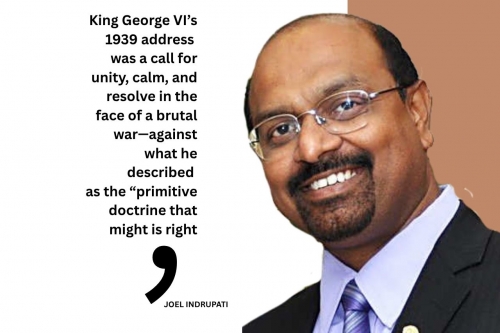
King George VI’s 1939 address was a call for unity, calm, and resolve in the face of a brutal war—against what he described as the “primitive doctrine that might is right.” Today, King Charles III echoes that spirit, urging renewed partnership and collective responsibility in an equally uncertain world.
The contexts differ, but the core message remains unchanged. Then, as now, the world stands at uneasy crossroads. Then, as now, the answer lies not in division, but in unity—tempered by calm, guided by wisdom, and anchored in a genuine desire for peace.
For history reminds us of a simple truth: when leaders rise above fear and ambition, and speak not just to power but to conscience, their words can steady nations.
And then perhaps, geopolitical structures will see less populism and ego, and more understanding and dialogue.
(The views and opinions expressed in this article are those of the author and do not necessarily reflect the official policy or position of the Daily Tribune)
Related Posts