

A logistics chain that moves and protects
TDT | Manama
Email: mail@newsofbahrain.com
For decades, global logistics was the invisible plumbing of the world economy—noticed only when it failed. Today, that perception has shifted radically. Logistics is no longer a background service; it is a primary instrument of national security and economic sovereignty. The recent surge of nearly 7,000 missile and drone attacks in the Gulf has transformed shipping lanes into frontlines, proving that the true value of a supply chain lies not in its speed, but in its resilience.
The crisis in the Strait of Hormuz has forced a reckoning. When urea prices jump 40% and LNG flows stall, the impact ripples far beyond the shoreline, threatening global food security and pushing developing nations toward sovereign debt crises. As GCC Secretary-General Jasem Mohamed Albudaiwi recently highlighted, the Council has moved swiftly to safeguard these vitals by activating a “Logistics Fast Track.” This emergency blueprint hinges on multimodal diversion: rerouting shipments away from volatile Gulf ports toward stable terminals on the Red Sea and Arabian Sea. This is supported by unprecedented regional cooperation, including coordinated customs facilitation designed to keep energy and fertilizers moving despite the blockade.
However, as we build these new “logistics blueprints,” we face a second, quieter crisis: the environmental cost of rapid infrastructure expansion. Balancing emergency logistics with ecological concerns is the next great challenge. We cannot trade maritime security for environmental degradation.
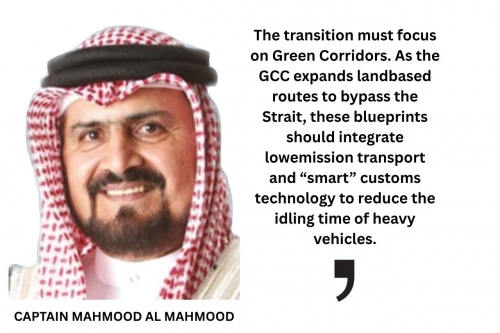
The transition must focus on Green Corridors. As the GCC expands land-based routes to bypass the Strait, these blueprints should integrate low-emission transport and “smart” customs technology to reduce the idling time of heavy vehicles. Furthermore, any expansion of Red Sea port capacity must adhere to strict “Blue Economy” standards to protect fragile marine ecosystems. By embedding sustainability into these alternative routes now, the GCC can ensure that the race for security doesn’t come at the expense of the planet. In this new era, a truly “strong” logistics network is one that is both unbreakable and sustainable.
(Captain Mahmood Al Mahmood is the Editor-in-Chief of The Daily Tribune and the President of the Arab-African Unity Organisation for Relief, Human Rights and Counterterrorism)
Related Posts