

The Ant Has a Story to Tell
TDT | Manama
Email: mail@newsofbahrain.com
Imagine returning to Bahrain after a holiday in Australia or Argentina. Somewhere inside your luggage or hidden within your clothes, a tiny ant unknowingly makes the journey with you. To most people, that may sound harmless. But to an environmental scientist, it could trigger immediate alarm bells.
Because some invasions do not arrive with noise, armies or warning signs. Sometimes, they arrive silently… one tiny insect at a time.
Have you heard the story of the infamous yellow crazy ants and their vast supercolonies? It sounds almost like science fiction. Yet, it is frighteningly real.
Unlike ordinary ant colonies that compete and fight among themselves, yellow crazy ants developed a completely different survival strategy: cooperation. Separate colonies merge into gigantic interconnected networks, allowing them to spread rapidly and endlessly. Over time, these supercolonies grew into billions of ants operating almost like a highly organised civilisation.
As the ants expanded, forests began to change slowly. Animals disappeared silently. Ecologists even began referring to some affected regions as “silent forests”.
The scale of the crisis became evident on Christmas Island, a remote Australian territory in the Indian Ocean renowned for its unique rainforest ecosystem and the spectacular migration of millions of giant red crabs.
Yellow crazy ants spread aggressively across the island, forming massive colonies that consumed vast stretches of rainforest.
The island’s ecological balance depended heavily on its red crabs. These crabs played a critical role in maintaining forest health by clearing leaf litter, recycling nutrients, controlling weeds and preserving the natural structure of the rainforest floor.
But these invasive ants launched a devastating assault. They sprayed formic acid into the crabs’ eyes and joints, blinding and dehydrating them before eventually killing them. Nearly 20 million crabs were wiped out.
The consequences were catastrophic. Without crabs maintaining the forest floor, weeds spread uncontrollably, snail populations increased, tree health declined, and several native species began to disappear. The ants also cultivated scale insects that produced sugary honeydew — a food source that strengthened the ant colonies while simultaneously damaging the trees.
Australia responded with one of the world’s most aggressive environmental control operations. Helicopters conducted aerial baiting campaigns over dense rainforests. Scientists surveyed more than 1,000 ecological sites, tracked ant movement and monitored declining crab populations. Environmental strike teams were deployed across the island.
The battle on Christmas Island eventually taught scientists a frightening lesson: yellow crazy ants were not the only species capable of building such organised invasions. Across the world, researchers soon discovered another tiny empire quietly expanding beyond borders — one that many experts believe is even more sophisticated in its strategy for survival and domination.
The Argentine ant soon emerged as another global ecological threat. These tiny Argentine ants behave like a highly organised army, spreading across cities, farms and forests without internal conflict. It is almost like a 24-hour task force that neither sleeps nor recognises borders.
Originally native to South America, they may appear harmless at first glance. However, scientists now consider them among the most invasive species on Earth.
They spread rapidly through shipping routes, cargo containers, plants and human travel. Over time, they established enormous supercolonies that stretched for thousands of kilometres along the Mediterranean coast of Europe and parts of California. Researchers discovered something extraordinary — ants from distant colonies did not attack one another. Instead, they cooperated as though operating under a single global command system.
The success of their invasion rested on one simple principle: cooperation.
Slowly, these ants also began reshaping ecosystems. Native ant species disappeared. Birds, reptiles and insects that depended on the original ecological balance were affected. Billions of dollars have been spent on surveillance, treatment and ecological recovery, yet countries around the world continue to battle invasive ant species today.
This story carries a far bigger lesson than simply the danger posed by insects.
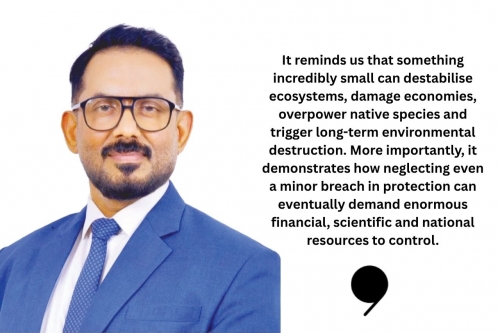
It reminds us that something incredibly small can destabilise ecosystems, damage economies, overpower native species and trigger longterm environmental destruction. More importantly, it demonstrates how neglecting even a minor breach in protection can eventually demand enormous financial, scientific and national resources to control.
The greatest threats do not always arrive loudly. Sometimes, they crawl in unnoticed.
(P. Unnikrishnan is the Chairperson and Managing Director of The Daily Tribune)
Related Posts