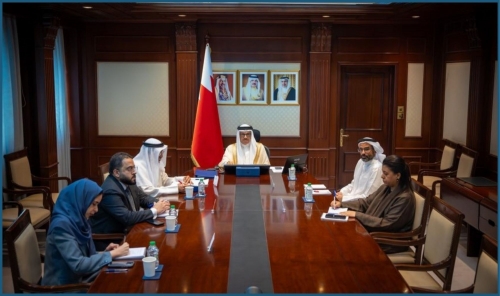
The Kingdom of Bahrain, holding the presidency of the Arab League Ministerial Council at the ministerial level for its 165th session, chaired a high-level virtual meeting today led by Foreign Minister Dr. Abdullatif bin Rashid Al Zayani.
The meeting brought together foreign ministers from Arab states, along with the Secretary-General of the Arab League, Ahmed Aboul Gheit, to discuss the implications of recent Iranian attacks on Gulf Cooperation Council countries and other Arab states. Discussions also focused on resulting civilian and material losses, as well as the broader impact of restrictions on international navigation in the Strait of Hormuz, which have raised concerns over global energy security, food supply chains, and international trade stability.
In his opening remarks, Dr. Al Zayani stressed that the meeting is taking place amid highly sensitive regional and international circumstances, calling for stronger Arab coordination and joint action to serve shared interests and address current challenges. He reaffirmed Bahrain’s commitment to supporting Arab unity and strengthening cooperation and solidarity among member states to safeguard Arab national security and protect regional stability.
He also expressed Bahrain’s appreciation for the constructive engagement of Arab countries during the extraordinary ministerial session held on 8 March, which responded to the attacks on Gulf and Arab states. The resulting resolution affirmed the right of affected countries to legitimate self-defense, individually or collectively, in accordance with Article 51 of the United Nations Charter, and supported their right to pursue international legal avenues, including the UN Security Council and General Assembly.
Bahrain further announced that, on behalf of the GCC states and Jordan, it had submitted a draft resolution to the United Nations Security Council, which was adopted on 11 March 2026 as Resolution 2817. The minister described this as a reflection of the international community’s commitment to safeguarding sovereignty and maintaining global peace and security.
He also noted that the resolution received broad support from 136 UN member states, underscoring what he described as a strong international consensus on protecting state sovereignty and addressing threats to regional and global stability.