

Where Ideas Are Built, Not Shown
In Bahrain’s evolving cultural landscape, Al Riwaq Art Space occupies a position shaped less by spectacle and more by sustained engagement. Established in 1998 as a commercial gallery, the space gradually shifted direction, expanding into a non profit campus for art and design that prioritises process, research and public interaction over display alone.
Origins
From its early years, Al Riwaq played a quiet but influential role in supporting contemporary and conceptual practices in Bahrain. Its programmes moved beyond exhibitions to include lectures, residencies and educational initiatives, contributing to the transformation of the Block 338 neighbourhood in Adliya. That phase marked a turning point where art became embedded in everyday urban life rather than confined to gallery walls.
Shift
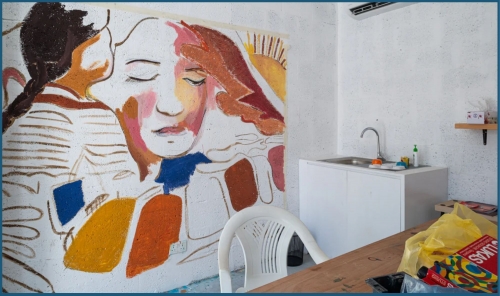
Today, Al Riwaq operates from its current location in the Qufool area, within a historic residence that once hosted private social gatherings. The building has been reimagined as a campus for creative practice, opening its spaces to artists and the wider public. This move reflects a deeper transformation in identity, marking an evolution from commercial beginnings to a non profit model grounded in accessibility, experimentation and cultural exchange.
Material
Walking through the campus, materials carry as much meaning as the artworks themselves. Many of the installations and sculptural forms are created using palm fronds, woven khous and found objects, including a piece constructed from parts of a hand broom. These choices foreground local craft traditions while questioning how everyday materials can be reimagined through contemporary design.
Spaces
Among the installations, An Interpretation of the Living Space presents furniture inspired by Mudhif structures and reed based craftsmanship from the marshlands. Traditional forms are abstracted into modern seating and surfaces, accompanied by a model of the original Mudhif to trace the evolution from past to present. In Unconstrained, reed mats and Mudhif style windows define a restrained interior where texture and tactility take precedence over polished form, offering a reflective reading of Arab urban architecture.
Practice
Beyond exhibitions, Al Riwaq runs programmes ranging from residencies to long and short format courses and workshops. These initiatives emphasise experimentation, theoretical discussion and mentorship, positioning the space as a site for learning and dialogue rather than promotion. As a non profit institution, its role remains focused on cultivating artistic inquiry and public engagement within Bahrain’s cultural ecosystem.
Related Posts