

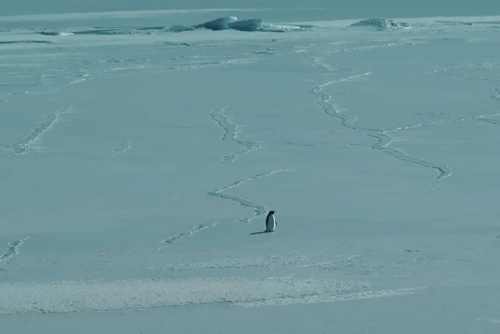
What’s behind that ‘Nilhist Penguin’ walking to the mountains?; science explains
Email: online@newsofbahrain.com
A short, haunting clip of a lone Adélie penguin trekking away from its colony toward the desolate Antarctic mountains has become the definitive viral sensation of 2026. Dubbed the ‘Nihilist Penguin' by social media users, the footage has inspired millions of memes, ranging from existential humour to symbolic meditations on burnout and rebellion. While the internet views this bird as a philosopher-king rejecting the colony, the reality is a fascinating and somewhat tragic intersection of cinematic history and wildlife biology.
The Origin of a Masterpiece
The footage actually dates back nearly two decades, appearing in Werner Herzog’s 2007 documentary Encounters at the End of the World. In the film, Herzog observes a penguin that inexplicably ignores the sea, its only source of food, to march 70 kilometres inland toward certain death. Herzog’s narration, which questions whether an animal can go insane or simply lose its mind, provides the brooding atmosphere that has made the clip so attractive to modern audiences. In a year defined by digital noise, the silent, purposeful walk of a flightless bird toward the horizon has struck a profound cultural nerve.
Human Meaning vs. Animal Instinct
The surge in the clip's popularity is largely driven by anthropomorphism, the human tendency to project our own complex emotions onto animals. On platforms like TikTok and X, the penguin is framed as a symbol of radical independence or an individual facing an existential crisis. Captions such as ‘The penguin knows’ or ‘Heading toward oblivion’ reflect 2026’s collective mood of exhaustion and the desire to step away from societal norms. However, scientists warn that while the footage is emotionally resonant, it is a poor representation of actual penguin psychology.
Scientific Explanations for the ‘Death March’
From a biological perspective, the penguin's behaviour is considered an anomaly rather than a philosophical choice. Researchers like Dr David Ainley, who appeared in the original documentary, suggest several less poetic reasons for the bird's wandering. Young or inexperienced penguins can experience navigational disorientation, losing their ability to use the sun or magnetic fields for direction. Other potential causes include underlying illness, neurological injury, or extreme stress that disrupts the bird's innate survival instincts. While the internet sees a hero, science sees an individual variation, a rare glitch in the natural order.
A Modern Symbol of Isolation
Despite the scientific explanations, the ‘Nihilist Penguin’ remains a powerful emblem for the current year. It represents a rare moment where a viral trend overlaps with deep, introspective themes. For social media users, the truth of why the penguin is walking is less important than the feeling it evokes: the universal experience of feeling lost or choosing a path that no one else understands. Whether it is a ‘glitch in nature’ or a ‘rebel with a cause’, the lone waddler continues to capture the world's imagination.
Related Posts