

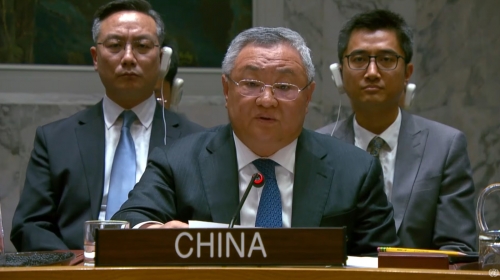
Fu Cong: “Root Causes Are Clear” as China Criticises US and Israel Actions
At a recent meeting of the United Nations Security Council, China’s Permanent Representative to the United Nations, Fu Cong, called for immediate de-escalation of tensions in the Middle East, warning that the ongoing conflict is having severe consequences for regional stability and the global economy.
Speaking during the session of the United Nations Security Council, Fu said the month-long conflict and its spillover effects are “dealing a heavy blow to regional and global peace and stability” and are also disrupting global economic activity. He stressed that the situation is not in the interest of any country and urged all parties to exercise restraint.
China argued that the root causes of the crisis are “clear,” stating that the United States and Israel carried out military strikes against Iran without Security Council authorization and while diplomatic negotiations were still ongoing. Fu said such actions, involving the United States, Israel, and Iran, violate the principles of the UN Charter and fundamental norms of international relations.
The Chinese envoy also emphasized the need to respect the sovereignty and territorial integrity of Gulf states, while ensuring the protection of civilians and civilian infrastructure. He specifically highlighted the importance of safeguarding maritime security and energy infrastructure in the region, particularly around the Strait of Hormuz, calling for the uninterrupted flow of international shipping and energy supplies.
Fu stated that China does not support attacks on Gulf states and opposes any disruption to navigation in the Strait of Hormuz, urging all sides to ensure that commercial shipping can resume normal operations without threat or obstruction.
During the session, China also addressed a draft resolution under discussion at the Council, saying it had engaged constructively in negotiations but believed the text failed to reflect the full complexity of the situation. Fu argued that the resolution did not adequately identify the root causes of the conflict and contained language that could be interpreted as one-sided, warning that this could risk escalating tensions further.
China cautioned the Security Council against rushing to a vote, saying its actions should focus on de-escalation rather than providing legitimacy for unauthorized military operations. Fu referenced past international crises, including Libya and developments in the Red Sea region, as examples of situations where Council actions had unintended consequences that should not be repeated.
China ultimately voted against the draft resolution, with Fu stating that it would have sent the wrong signal and potentially worsened the situation. He added that the Council must ensure its decisions help “cool the temperature” rather than inflame tensions.
Calling the conflict “a war that should never have happened,” China urged an immediate cessation of hostilities and a return to diplomatic engagement. It also called on the United States and Israel to halt military actions, while urging Iran to avoid attacks on Gulf-related infrastructure and to address the legitimate concerns of neighbouring states.
Finally, China welcomed diplomatic efforts by countries including Pakistan, Egypt, and Saudi Arabia aimed at promoting dialogue and restoring regional stability, reiterating its support for negotiations as the only viable path toward lasting peace.
Related Posts