

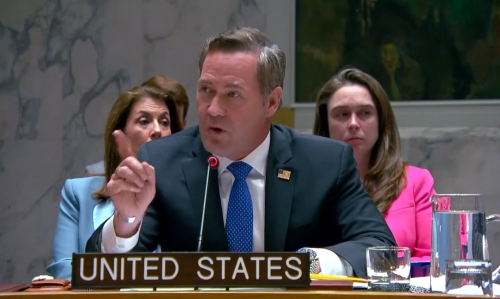
US Envoy Delivers Blistering Critique of Iran at Security Council
During the Security Council session, U.S. Ambassador to the United Nations Michael Waltz delivered a sharply worded intervention, accusing Iran of escalating regional instability and endangering civilian life and international shipping. He alleged that Iran had embedded military assets within civilian infrastructure, stating, “Iran hides military hardware in hospitals, in schools, in civilian neighborhoods for propaganda purposes in the most sick and despicable way,” adding forcefully, “Enough is enough.”
The U.S. envoy stressed Washington’s support for Bahrain and its Gulf partners, framing the vote as a defining moment for global security. “The United States stands with Bahrain, the United States stands with the people of the Gulf at this moment of reckoning,” he said, describing the situation as “a time for choosing” for the international community.
He further argued that opposition to the resolution reflected alignment with destabilizing forces, referencing previous Security Council actions and claiming that Iran had continued to violate international norms. He said the Council had previously adopted widely supported resolutions condemning attacks and threats to maritime security, and insisted that coordinated action had previously led to reductions in regional escalation.
The U.S. ambassador also warned of the global consequences of instability in the Strait of Hormuz, describing it as a vital corridor for energy and goods. He claimed that disruptions to shipping could trigger global supply chain shocks, stating that vessels carrying essential commodities such as oil, fertilizer, and medical supplies were being threatened, with potential consequences including energy shortages and humanitarian strain.
Expanding his remarks, he accused Iran of broader regional aggression, including the use of missiles and drones against neighboring states and civilian infrastructure, as well as support for armed proxy groups. He also cited international reports alleging that Iran had militarized civilian areas and engaged in destabilizing activities across the region.
The debate underscored deep divisions within the Security Council over how to address maritime security in the Gulf, with Russia and China using their veto power to block the resolution. The outcome leaves the issue unresolved at the UN level, despite continued concerns among Gulf states and their allies over the security of international shipping routes through the Strait of Hormuz.
Related Posts