

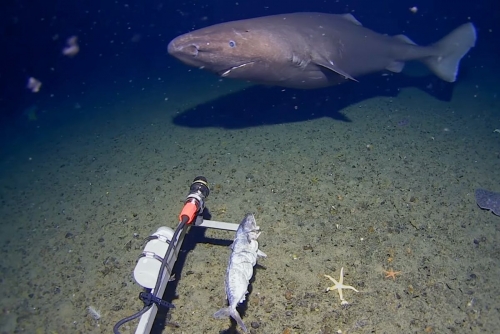
Shark Spotted in Icy Antarctic Depths, Redefining Ocean Life
Email: online@newsofbahrain.com
Antarctica: For the first time in recorded history, scientists have captured video footage of a shark swimming in the Antarctic Ocean, an area long believed too cold to support these predators, researchers confirmed this week. The shark appeared in footage collected in January 2025 but published only recently.
The shark identified by experts as a type of sleeper shark was filmed by a deep-sea camera operated by the Minderoo-UWA Deep-Sea Research Centre near the South Shetland Islands, off the Antarctic Peninsula. The water temperature at a depth of about 490 metres (1,608 feet) was measured at just above freezing.
Researchers described the sighting as unexpected because sharks were not previously documented this far south. Many scientists assumed the frigid conditions and limited food supply made Antarctic waters inhospitable for large sharks. Yet the footage shows the slow-moving animal gliding over the seabed, challenging long-held assumptions about marine life in the region.
The shark observed is estimated to be between 3 metres (10 feet) and 4 metres (13 feet) long a substantial size for a deep-sea predator. Experts say such sharks might have lived in these extreme conditions for years undetected, partly because deep-sea research tools are deployed only during short windows in the Antarctic summer.
Researchers also noted that the ocean around Antarctica is highly stratified into layers with varying temperatures. The shark appears to have stayed at depths where water is relatively warmer than in deeper or shallower layers suggesting a possible survival strategy in near-freezing conditions.
While climate change could influence the range of some marine species, scientists caution that current data are too limited to determine whether this shark’s presence is a recent shift or part of a long-unseen Antarctic ecosystem. The discovery nonetheless opens new questions about biodiversity and adaptation in one of Earth’s most extreme ocean environments.
Photo credit: Youtube/@deepseauwa
Related Posts