

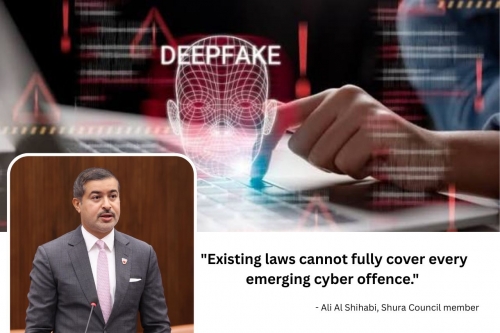
Lawmakers Target Deepfake Crime
TDT | Manama
Email: mail@newsofbahrain.com
A fake voice, a stolen face and a made-up video are now enough to wreck a person’s name, fool a company or turn a lie into proof.
That is the threat Bahraini lawmakers say the law must confront as they press for deepfake abuse to be made a clear criminal offence.
A Bill put forward by members of the Shura Council would amend the Information Technology Crimes Law to punish the creation or faking of visual or audio material through digital tools when it harms a person’s name, honour or standing, exposes them to contempt or punishment, or is used for an unlawful aim.
The proposal has reopened debate over how far Bahraini law can deal with a form of digital crime that reaches beyond stolen money and breached accounts, instead attacking trust in a person’s voice, face and identity.
Recent global figures show deepfakes now account for one in five biometric fraud attempts worldwide. Fake AI-made selfies rose by 58 pc in 2025, while advanced multi-step attacks increased by 180 pc, pointing to the speed with which fraud built on false images, voices and video is spreading.
The Middle East is not outside the trend. International indicators show digital fraud in the region grew by 19.8 pc, among the highest regional rates, while 56 pc of firms in the UAE said they had faced deepfake videos, above the global average.
Those backing the Bahraini proposal, along with legal specialists, say current laws were not written for AI-made material that looks real and is hard to disprove before the damage is done.
Psychologists also warn that the harm can go beyond a person’s name, reaching their sense of safety, identity and self-image, especially among children and people most at risk.
Shura Council member Ali Al Shihabi said Bahrain, through the Council, had moved early to organise the use of artificial intelligence, with a draft law now before the Council of Representatives to complete its legislative path.
He said the proposed deepfake amendment was a response to rapid change in software and algorithms, and to the risk of leaving such tools without legal controls when they can be used in ways that harm public calm and trust.
Al Shihabi said the aim was to criminalise a specific act: making or altering audio or visual material through information technology when it damages a person’s reputation or honour, makes them a target of contempt or penalty, or is used for an unlawful purpose.
He said current laws do not contain a clear provision dealing with this new conduct, adding that the proposal was not aimed at banning technology itself but at stopping its misuse while leaving room for invention.
He said Bahrain had already laid the foundation for a wider law on artificial intelligence, which began as a Shura Council proposal, and that the deepfake measure could fit within that broader legal framework.
Sending the proposal to the government for its view, he said, would help assess the need for such a legal step and support co-operation between the legislative and executive branches in dealing with new digital offences.
Related Posts