

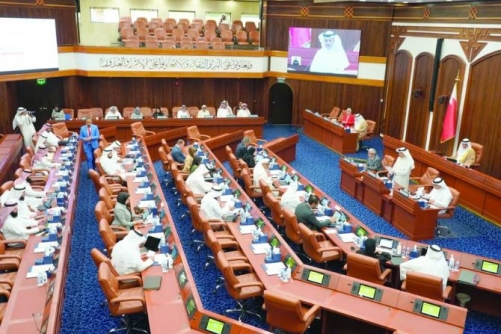
Shura Council to Debate Bills on State-Owned Company Profits
TDT | Manama
Email: mail@newsofbahrain.com
The Shura Council is scheduled to discuss two draft laws on Sunday aimed at directing a larger share of profits from state-owned companies to the public budget. However, the council’s Financial and Economic Affairs Committee has recommended rejecting the proposals in principle, citing potential conflicts with existing legislation and concerns over the financial and administrative independence of public entities.
The two bills originate from earlier proposals approved by Parliament.
The first draft law seeks to amend Article 10 of Decree-Law No. 39 of 2002 on the State Budget, requiring the revenues of all public authorities and institutions—along with the state’s net returns from wholly owned companies and its share of profits from other companies after deducting the legal reserve—to be transferred to the general treasury.
The second bill would require that at least 50 percent of the state’s net profits from Bahrain Mumtalakat Holding Company and Bapco Energies be included in the annual state budget.
After reviewing the proposals and hearing the views of the Ministry of Finance and National Economy, Mumtalakat, and Bapco Energies, the committee concluded that the objectives of the bills are already achieved under current laws. It noted that state-owned companies are subject to oversight by the Financial and Administrative Audit Bureau and are required to submit their budgets and final accounts to the Ministry of Finance.
According to the committee, this makes the proposed legislation largely redundant, as it duplicates provisions already in place without introducing substantive changes.
The committee also argued that the proposals conflict with the framework governing the state budget law, which allows certain revenues to remain outside the general treasury if stipulated by other legislation.
Furthermore, members warned that the proposals could undermine the financial and administrative independence granted by the constitution to public authorities and institutions, potentially placing them at odds with Bahrain’s existing fiscal framework.
The committee added that approving the laws could also result in the state assuming the financial losses and operational costs of the concerned companies, which may increase public spending and widen the budget deficit. It emphasized that any such step should be preceded by a comprehensive study assessing its potential financial impact.
Related Posts