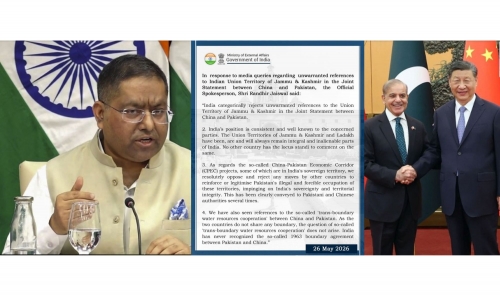
Speaking in New Delhi on Tuesday, India’s Foreign Ministry spokesperson, Shri Randhir Jaiswal, said the Union Territories of Jammu and Kashmir and Ladakh “have been, are and will always remain integral and inalienable parts of India”.
He added that no other country had the authority to comment on the matter, stressing that India’s position was “consistent and well known” to both Beijing and Islamabad.
The response came after China and Pakistan issued a joint statement that included references to Jammu and Kashmir, a region claimed in full by both India and Pakistan but administered in parts by each side.
India also renewed its criticism of the China-Pakistan Economic Corridor (CPEC), a multi-billion-dollar infrastructure and energy initiative that forms part of China’s Belt and Road Initiative.
New Delhi said some CPEC-related projects were located in territory it considers part of its sovereign land. The Indian government accused both countries of attempting to “reinforce or legitimise Pakistan’s illegal and forcible occupation” of these areas.
Mr Jaiswal said India had repeatedly conveyed its objections to both Chinese and Pakistani authorities.
The spokesperson also rejected references in the joint statement to what was described as “trans-boundary water resources cooperation” between China and Pakistan.
India argued that the two countries “do not share any boundary”, and therefore such cooperation did not arise in the manner described.
New Delhi further reiterated that it has never recognised the 1963 boundary agreement signed between Pakistan and China, under which territory claimed by India was ceded to Beijing.
Relations between India and Pakistan remain tense over Kashmir, while ties between India and China have also faced strain in recent years because of border disputes and regional strategic competition.