

The Question Beneath the Knife
TDT | Manama
Email: mail@newsofbahrain.com
His knife was right against my throat.
For a brief second, he paused, looked at me through the mirror, and asked: “Do you trust AI?”
I stayed still while the sharp blade carefully trimmed the thin line of beard near my neck. Then I smiled and replied:
“How can I sit here without trust? You could cut my throat in a fraction of a second if you wanted to.”
Before I could continue, he laughed softly and said:
“But you trust me because you know me. AI is something people don’t really know closely. So how can they trust it?”
That question opened up one of the most unexpected conversations I’ve had in recent times.
I told him, “Have you ever met the engineer who designed the building we are sitting in? Or the contractor who built it? Still, we sit and work inside without fear because we trust them. When we board a flight, most of us don’t know the pilot personally either. Yet we trust him with our lives.”
Trust, in many ways, is blind. Humanity has survived and grown largely because people believed in one another.
I was sitting in a small salon near Salmaniya. The young barber from Kerala had somehow become my favourite hairstylist over the past year. What made him interesting was not just his skill, but his endless curiosity. He never allowed silence to settle in the room. Every haircut turned into a discussion about life, society, technology, or politics.
Recently, he had been hearing a lot about AI being used in wars and military systems.
“You know,” he said, “there’s a big debate happening in America about whether AI should be allowed to access dangerous military knowledge.” He had clearly been following the subject closely. And honestly, it is a serious debate.
Some people argue that overly restricting AI could weaken technological leadership and slow innovation. Others fear that advanced AI could help create biological weapons, make cyberattacks easier, or even power autonomous weapons capable of killing without direct human control.
Then he suddenly looked at me and asked the real question:
“Are we progressing… or slowly moving toward self-destruction?”
I paused for a moment.
There are already reports of intelligent missile systems capable of identifying human movement and striking targets with terrifying precision. Technology is advancing at a pace that can sometimes feel difficult to comprehend.
“So in the future,” he asked, “will wars become AI versus AI?”
“Possibly,” I admitted, with my limited understanding of the subject.
Then came another question.
“Do you think people will reach a stage where most humans may not even need to work for survival?”
That thought reminded me of my interview with A. Sivathanu Pillai, one of the minds behind the BrahMos missile project. Technological change is happening so rapidly that many professions may eventually transform beyond recognition.
The barber slowly removed the cloth around my neck while continuing the conversation.
“So how do we survive in such a future?” he asked.
I told him honestly:
“It’s going to be challenging — not just for us, but for the entire world.”
Then I added something that made him stop for a second.
“I think we may even be heading toward a future where humans could choose how long they want to live.”
He looked shocked.
“Serious?”
I nodded.
“Today, we can already replace many body parts — kidneys, hearts, liver, artificial hands and legs. Computers are becoming more intelligent in many ways. The biggest remaining challenge is not intelligence but memory and emotions. The day technology learns how to preserve or replicate human memory and emotions perfectly, humanity itself may change forever.”
For a moment, he became silent.
Then he switched on the hair dryer, carefully adjusted my hairstyle, and gave the finishing touches with complete concentration.
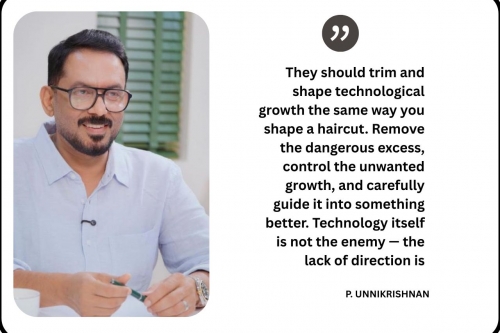
“You know what world leaders and decision-makers should seriously do?” I told him. “They should trim and shape technological growth the same way you shape a haircut. Remove the dangerous excess, control the unwanted growth, and carefully guide it into something better. Technology itself is not the enemy — the lack of direction is.”
He smiled while continuing his work.
As I asked him to make a few final adjustments, he suddenly looked at me through the mirror again and asked:
“But do you think AI can replace my job too?”
I smiled back.
“Maybe. But even if a robot cuts hair perfectly, I still may not choose it if I have someone like you — someone who can speak from the heart.”
He burst into laughter.
“So,” he said, “I may still have the option to remain your hairstylist forever.” “Only if I choose to live forever,” I replied. And both of us laughed together.
(P. Unnikrishnan is the Chairperson and Managing Director of The Daily Tribune)
Related Posts