

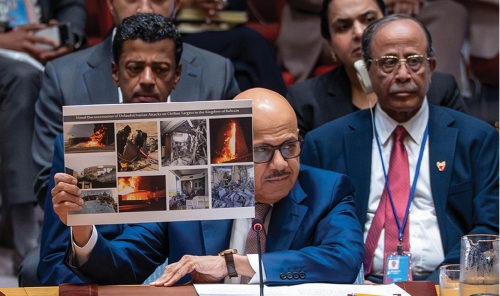
Bahrain Reports 808 Attacks in UN Briefing, Calls for Accountability Over Iran Strikes
FM Dr. Abdullatif bin Rashid Al Zayani, has stated that the recent Iranian attacks on the Kingdom—carried out using ballistic missiles and drones—are not isolated incidents, but part of a sustained and repeated pattern of aggression. He noted that these attacks have targeted densely populated civilian areas and vital infrastructure, continuing since February 28 and persisting even after the signing of a memorandum of understanding between the United States and Iran.
Speaking at an emergency session of the United Nations Security Council held at Bahrain’s request, the Foreign Minister urged the Council to reaffirm its condemnation of repeated Iranian actions and to compel Tehran to immediately halt its attacks. He also called for full compliance with UN Security Council Resolution 2817 (2026), as well as adherence to international law, along with the establishment of an effective monitoring and accountability mechanism.
Al Zayani emphasized that Bahrain initiated the emergency session out of its responsibility to uphold international peace and security, expressing confidence that the Security Council would not remain passive in the face of what he described as a clear challenge to its authority, recalling the Council’s earlier condemnation of similar attacks on Gulf states and Jordan under Resolution 2817 (2026).
He further highlighted Bahrain’s high population density, noting it ranks first in the Arab world and third globally, where industrial facilities and residential areas are closely interconnected. According to him, Bahrain has recorded a total of 808 attacks since the beginning of the conflict, including 203 ballistic missiles and 605 drone strikes.
The Foreign Minister added that these attacks have deliberately targeted civilian areas and critical infrastructure, resulting in three deaths and 465 injuries among civilians, including women and children. He warned that without preventive measures taken by national authorities, the damage would have been significantly worse. He also stressed that the impact extends beyond physical destruction, causing fear, disruption, and intimidation among civilians—acts prohibited under international humanitarian law, which criminalizes actions intended to spread terror among civilian populations.
Related Posts