

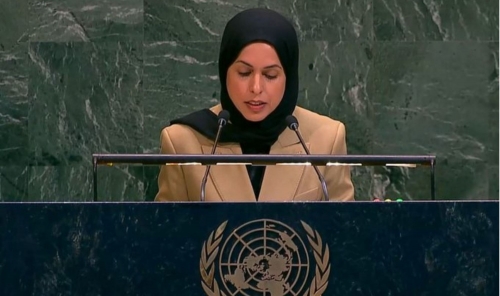
Qatar Reaffirms Commitment to Global Counter-Terrorism Strategy at UN
The State of Qatar has reaffirmed its unwavering condemnation of terrorism in all its forms and manifestations, describing it as a grave threat to international peace and security, sustainable development, human rights, and the rule of law.
Addressing the United Nations General Assembly during the ninth review of the UN Global Counter-Terrorism Strategy at the organisation's headquarters in New York, Her Excellency Sheikha Alia Ahmed bin Saif Al Thani, Qatar's Permanent Representative to the United Nations, reiterated the country's commitment to the comprehensive implementation of the Global Counter-Terrorism Strategy and its four pillars, alongside relevant UN General Assembly and Security Council resolutions and international and regional agreements.
She stressed that effectively preventing terrorism requires addressing the underlying conditions that fuel its spread, including armed conflicts, foreign occupation, hate speech, and human rights violations, which terrorist organisations exploit for recruitment and radicalisation. She added that Qatar continues to support initiatives focused on youth empowerment, quality education, and promoting dialogue and mutual understanding.
The Permanent Representative also underscored the importance of promoting tolerance and respect for religious values while rejecting attempts to associate terrorism with any religion, nationality, civilisation, culture, or ethnic group. She called for stronger efforts to combat terrorist threats driven by intolerance, racism, xenophobia, and Islamophobia.
Highlighting Qatar's partnership with the United Nations Office of Counter-Terrorism (UNOCT), Sheikha Alia noted that Qatar has been one of the Office's earliest and largest supporters. Since 2019, the country has provided an annual grant of $15 million, a commitment renewed through 2026. With total contributions exceeding $141 million—representing nearly one-third of the UN Counter-Terrorism Trust Fund—Qatar remains the Office's largest donor.
She said Qatar continues to support the Office's leadership, coordination, capacity-building, and technical assistance programmes, including initiatives aimed at countering terrorist travel, protecting vulnerable targets, and enhancing security for major international sporting events. Since 2020, Doha has also hosted the International Hub on Behavioral Insights for Countering Terrorism, one of the Office's leading programme centres outside UN headquarters.
Welcoming the UN Office of Counter-Terrorism's ongoing efforts, the Qatari envoy praised its collaboration with members of the UN Global Counter-Terrorism Coordination Compact in supporting member states through transparent, accountable, and results-oriented frameworks.
On the domestic front, Sheikha Alia said Qatar has continued strengthening its legislative and institutional framework to combat terrorism, including measures to prevent terrorist financing and criminalise terrorist acts in line with international obligations. She highlighted the country's comprehensive national strategy to counter terrorism and violent extremism, which aligns fully with the UN Global Counter-Terrorism Strategy and focuses on prevention, protection, prosecution, and recovery through coordinated action led by the National Counter-Terrorism Committee.
Concluding her address, the Permanent Representative reaffirmed Qatar's commitment to supporting international efforts to combat terrorism and violent extremism through enhanced cooperation, respect for international law, and sustained partnerships under the United Nations framework.
Related Posts