

Call for ‘beehive’ national strategy
TDT | Manama
Email: mail@newsofbahrain.com
Bahrain must urgently mobilise a broad national response involving government, private sector leaders, academics and financiers to confront an escalating economic shock driven by regional tensions and disrupted trade routes, a senior lawmaker said.
Jamal Fakhro, First Deputy Chairman of the Shura Council, said that Bahrain needed to accelerate a coordinated national response to the impact of the armed conflict between Iran and the continued disruption in the Strait of Hormuz. He stated that these issues have severely affected trade, tourism and wider business activity.
Speaking to The Daily Tribune, Fakhro called for creating a national economic forum operating “like a beehive”, bringing together bankers, traders, entrepreneurs and academics to design practical solutions beyond short-term government support.
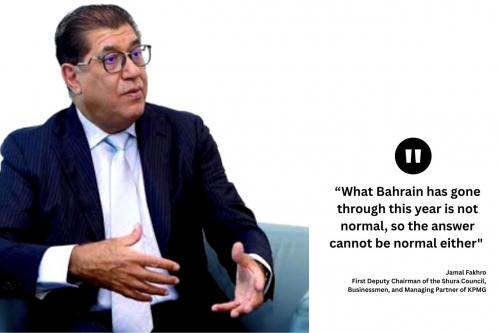
“What Bahrain has gone through this year is not normal, so the answer cannot be normal either,” he said, stressing that the scale of the disruption required a collective national effort rather than reliance on state aid alone.
He said the closure of the Strait of Hormuz had exposed Bahrain’s economic vulnerability as a small, trade-dependent country, noting sharp increases in freight costs and near-collapse conditions in sectors such as hospitality and logistics.
Fakhro pointed to hotel occupancy rates falling to as low as 2 percent in some cases, alongside steep increases in shipping costs and pressure on small and medium-sized enterprises.
He called for greater involvement from universities and experts in public debate, saying academics should play a stronger role in shaping economic recovery strategies.
“Today we need academics, their influential voice and their ideas,” he said.
He warned that small and medium-sized enterprises were under particular strain, noting that many lacked professional risk management structures and were vulnerable to ongoing shocks.
“The solution comes through unity,” he said, adding that a coordinated national effort could turn ideas from multiple sectors into workable economic strategies.
Related Posts