

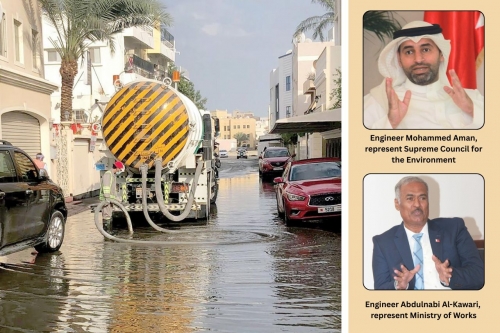
Flooding Concerns Addressed
TDT | Manama
Email: mail@newsofbahrain.com
The Northern Municipal Council held a dialogue session under the “Hayaakom” program to discuss environmental and health risks related to rainwater accumulation and waste management. The session included representatives from the Supreme Council for the Environment, the Ministry of Works, and the Ministry of Health, aiming to strengthen coordination and reduce risks caused by stagnant water and illegal dumping.
The session was chaired by Dr. Sayed Shubbar Al-Wedai and included representatives from various ministries, including Engineer Abdulnabi Al-Kawari (Ministry of Works), Dr. Ghada Abdulatif Al-Zayani and Mr. Mustafa Majid Salemain (Ministry of Health), and Engineer Mohammed Aman (Supreme Council for the Environment).
The program reflects efforts to enhance institutional cooperation and promote preventive environmental practices that protect public health.
Engineer Mohammed Aman explained that rainwater accumulation is not only an infrastructure issue but also an environmental and health concern, saying: “Pollution includes any harmful elements that may affect health directly or indirectly, including through rainwater that can spread diseases.”
He added that the council’s role begins after rainwater is collected, stressing the importance of preventing pollution from shifting between locations: “We ensure that solutions do not create new environmental problems.”
He also highlighted a monitoring system, developed in cooperation with the Ministry of Works that tracks waste transport vehicles using sensors. The system, implemented after a 2022 decision and activated in 2025, monitors loading, unloading, and illegal disposal activities.
So far, 1,270 vehicles have been licensed, 19 disposal sites identified, and 62 violations recorded in one year, with fines ranging from 7,000 to 10,000 Bahraini dinars. He also stressed the importance of community reporting, saying: “Citizens are the eyes of environmental protection.”
Engineer Abdulnabi Al-Kawari stated that the Ministry of Works is expanding drainage networks to reduce flooding and manage rainwater in residential areas.
Mr. Mustafa Majid Salemain from the Ministry of Health said water accumulation is continuously monitored, especially during the rainy season, adding that public reporting plays a key role in detecting issues early.
Dr. Ghada Al-Zayani emphasized that even small stagnant water sources can lead to mosquito breeding, noting that effective solutions require addressing the root cause and improving environmental sanitation through cooperation between authorities and the public.
Related Posts