

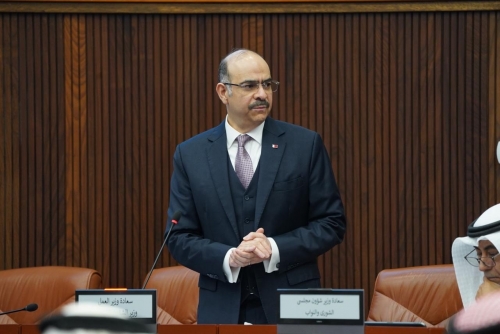
Labour Minister tells MPs parallel Bahrainisation scheme ‘raised compliance to 52 per cent’
TDT | Manama
Email: mail@newsofbahrain.com
Labour Minister, His Excellency Yousef Khalaf, told MPs yesterday that the “parallel Bahrainisation” scheme had lifted compliance with Bahrainisation ratios from 38 per cent before the parallel fee was introduced to 52 per cent now, a rise he put at about 14 per cent.
Replying during the sitting to MP Mohammed Salman Al Ahmed, H.E. Khalaf said the ministry had supplied figures up to October 2025 and could send updated numbers once the year’s data were closed.
Asked about the value of the system, and whether the Ministry of Labour and the Labour Market Regulatory Authority (LMRA) review it, he said the scheme was reviewed like other government systems, with checks on its efficiency, its usefulness, and its role in meeting the aims it was created for.
Figures
He said the figures since the system began in May 2016 backed a positive verdict.
The main aim, he told MPs, was to strengthen the preference for Bahrainis in the labour market and to treat Bahrainis as the first choice for jobs.
He said the scheme sat alongside other initiatives, tools and policies being studied and put into place for the same aim.
Work
In the same sitting, responding to MP Hassan Ebrahim, Khalaf spoke about work carried out since a directive by His Royal Highness Prince Salman bin Hamad Al Khalifa, the Crown Prince and Prime Minister, to ensure three job opportunities were offered to each jobseeker registered with the ministry by the end of 2025.
H.E. Khalaf said reducing the number of jobseekers to zero was something the ministry hoped for, but that hiring was a running process because new entrants kept joining the labour market as others found work.
He said that, during the period linked to the directive, the Cabinet on Monday announced the employment of 4,746 people, while 4,485 new jobseekers registered with the ministry over the same stretch of time.
Claims
H.E. Khalaf dismissed claims that the ministry forced employers to list vacancies, saying it increased outreach and asked for help but did not compel it. Some employers offered jobs of their own will, he said, while a ministry marketing team worked to feed vacancies into the national employment platform.
He added that the ministry had no way to force cooperation when an employer did not wish to take part.
The Minister also said measures had been taken to deal with disputes over jobseekers being recorded as refusing work.
Refuser
He said employers could no longer register a jobseeker as a refuser, and the power once held by an employment adviser to mark a jobseeker as “non-cooperative” had also been removed.
H.E. Khalaf said jobseekers had the right to appeal any decision issued by the ministry, including suspending unemployment benefit, ending entitlement, or recording someone as refusing an opportunity.
An appeals committee heard such cases, he said, and statistics showed many people who appealed provided evidence and had their cases decided by the committee on an impartial basis.
Related Posts