

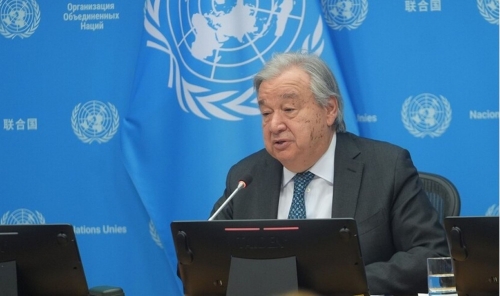
Guterres warns UN Charter faces “profound strain”
Climate crisis, inequality and debt pressures worsening instability worldwide
António Guterres, UNSecretary-General warned the international community that the principles of the United Nations Charter are facing unprecedented pressure, as wars, geopolitical tensions and global instability continue to grow.
Addressing the United Nations Security Council, the Secretary-General described the UN Charter as a “survival guide for humanity”, created in the aftermath of two world wars to ensure that international disputes are resolved peacefully and according to international law.
He said the Charter had helped prevent a third world war, supported decolonisation, advanced human rights and placed limits on the nuclear arms race over several decades.
However, Guterres warned that the foundations of the international system are now being challenged.
Seven major threats identified
The UN chief outlined seven immediate threats facing the world, beginning with what he called the erosion of respect for international law.
He said core principles including sovereign equality, territorial integrity and political independence are increasingly being ignored, while violations often go unanswered, leading to a growing culture of impunity.
Guterres also warned that geopolitical divisions are deepening, with mistrust between nations making international consensus harder to achieve. He said divisions within the Security Council often prevent unified action during major crises.
Rising conflicts and fears of escalation
The Secretary-General said the world is currently witnessing the highest number of conflicts since the founding of the United Nations.
He pointed to increasing external interference in wars, including the use of drones and other weapons that frequently target civilians and civilian infrastructure.
Guterres highlighted ongoing violence in the Middle East, Sudan and Ukraine, while expressing concern over recent statements by the Russian Federation regarding expanded strikes on Ukrainian defence facilities and command centres in Kyiv.
He also referred to reports of a Ukrainian drone strike on a college building and dormitory in Starobilsk, an area currently occupied by Russian forces.
The UN chief said attacks on civilians and civilian infrastructure must be condemned “wherever they occur”, warning that further escalation could prolong suffering and push peace efforts further out of reach.
He added that tensions remain high following Israel’s announcement of expanded operations in Lebanon, continued ceasefire violations in Gaza and uncertain negotiations between the United States and Iran over tensions in the Gulf.
Warning over global arms race and AI weapons
Guterres warned that the world is entering a dangerous new phase of military competition, with global military spending reaching record levels.
At the same time, he said increasingly advanced weapons are becoming cheaper to produce, while funding for humanitarian and development programmes is being reduced.
He cautioned that rapidly developing technologies, including artificial intelligence and autonomous weapons systems, are advancing faster than the world’s ability to regulate them, creating new risks for international peace and security.
Human rights and development under pressure
The Secretary-General also warned that human rights are facing what he described as a “full-scale attack” across many parts of the world.
He said civil, political, economic, social and cultural rights are being deliberately undermined, with serious consequences for societies and communities globally.
Guterres stressed that peace and development remain closely connected, warning that widening inequalities, rising debt burdens and limited access to financing are pushing many developing countries into deeper crisis.
He said the Sustainable Development Goals are increasingly slipping out of reach, adding that there can be “no peace without development, and no development without peace”.
Climate crisis increasing instability
The UN chief described climate change as another growing threat to global stability.
He said the climate crisis is acting as a “multiplier of threats”, increasing tensions both within and between countries while worsening instability worldwide.
Call for reform and stronger multilateralism
Guterres urged member states to strengthen international cooperation and recommit to the principles of the UN Charter.
He called for greater investment in conflict prevention, mediation and peacebuilding efforts, while insisting that international law and accountability must be applied consistently and without double standards.
The Secretary-General also renewed calls for reform of global institutions, arguing that international structures must reflect modern realities rather than the world order established in 1945.
Related Posts