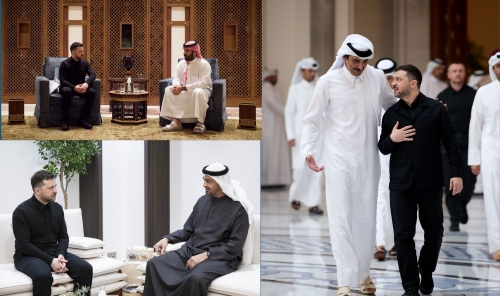
Ukrainian President Volodymyr Zelensky has announced that Ukraine is expanding defence and industrial cooperation with countries in the Middle East, highlighting advancements in drone warfare systems developed during the ongoing war.
Speaking about the evolving nature of the conflict, Zelensky said Ukraine was forced to develop its own counter-drone and defence technologies in response to the widespread use of Iranian “Shahed”-type drones by its adversaries. He added that these systems are now being shared with international partners in the region.
He noted that Ukraine’s battlefield experience has significantly reshaped global military understanding, stating that the country has become a key source of expertise in modern warfare, particularly in unmanned aerial systems and integrated air defence approaches.
Zelensky outlined two main areas of cooperation being pursued with partner countries: defence production and energy collaboration. The defence track includes weapons manufacturing, exchange of military experience, and the development of joint production facilities both in Ukraine and abroad. He also referred to broader “drone deals” that would include unmanned systems, electronic warfare capabilities, and integrated defence solutions.
The second area focuses on long-term energy partnerships, with agreements described as extending over a decade. According to Zelenskyy, Ukraine has already signed relevant arrangements with Saudi Arabia and Qatar, aimed at strengthening energy security and supply resilience.
He further emphasized plans for co-production and industrial development over the next ten years, including establishing manufacturing lines in partner countries and ensuring supply continuity during global disruptions. He also mentioned recent discussions related to fuel supply arrangements, including diesel provisions for potential shortages.
Zelensky concluded that Ukraine’s most valuable contribution is not only technology, but also the experience of its military personnel, which he described as a critical component of its international cooperation model. He said similar cooperation frameworks have already begun with three countries, marking the start of what he described as a long-term strategic export approach combining state, military, and private sector expertise.