


Fitch Ratings Raises Oil Price Forecasts Amid Prolonged Strait of Hormuz Disruption
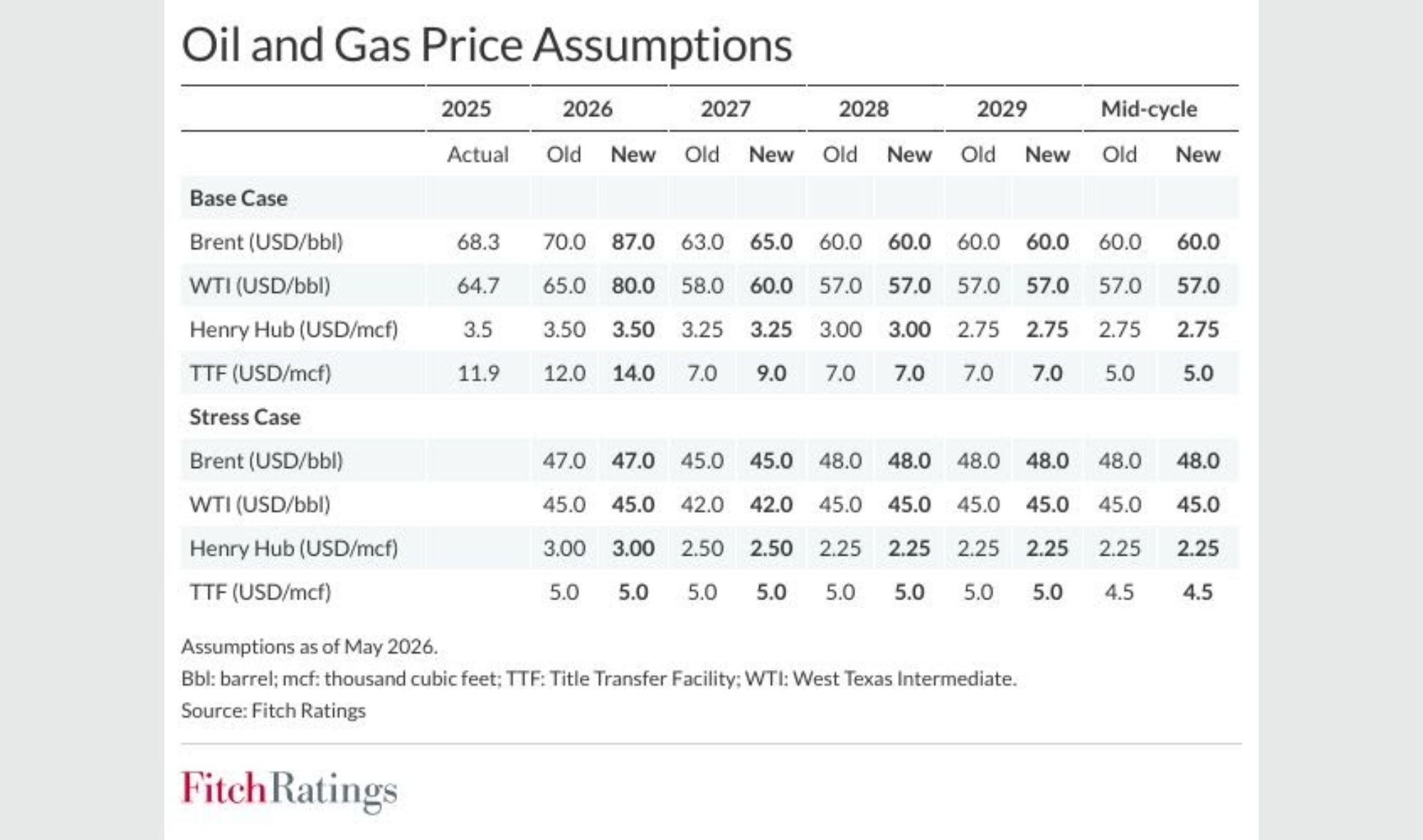
Fitch Ratings has raised its oil and gas price assumptions for 2026 and 2027, citing a longer-than-expected disruption in the Strait of Hormuz due to the ongoing Iran conflict.
According to Angelina Valavina, EMEA Head of Natural Resources and Commodities at Fitch Ratings, the revised outlook assumes the strategically vital waterway will begin reopening around July after an effective closure lasting approximately five months.
The Strait of Hormuz is one of the world’s most important energy transit routes, carrying around 15 million barrels of crude oil per day and 5 million barrels of oil products daily before the conflict — equivalent to roughly 20% of global oil consumption.
Fitch said the extended disruption has forced the agency to revise its Brent crude oil outlook higher, with prices expected to remain between USD100 and USD110 per barrel during the May-to-July closure period before easing to around USD70 per barrel by September as supply gradually stabilises.
The agency noted that the reopening process could still face uncertainty, although it expects oil production in the Gulf region to recover quickly because major infrastructure has not suffered significant damage.
Fitch also expects market oversupply to place downward pressure on prices later in the year. The agency estimates that OPEC could increase output close to maximum capacity to offset supply disruptions, while non-OPEC producers such as the United States, Kazakhstan, Venezuela and Russia are also expected to expand production amid higher prices.
The report highlighted that the global market had already adjusted partially through the release of around 400 million barrels of emergency oil reserves by the International Energy Agency and reduced demand caused by high prices and supply concerns.
Fitch estimates that demand destruction of approximately 5 million barrels per day — equal to 5% of global demand — may be required during the closure period to rebalance markets if no additional strategic reserves are released.
The agency added that weaker demand from the petrochemicals sector and reduced jet fuel consumption due to disrupted flights and elevated fuel prices could contribute to balancing the market.
Global oil inventories remain at historically high levels, with stocks reaching 8.2 billion barrels in January 2026 — comparable to levels seen during 2020. China alone is estimated to hold around 1.2 billion barrels in reserves, enough to cover its Hormuz-linked imports for more than eight months.
In the natural gas market, Fitch also raised its assumptions for European Title Transfer Facility gas prices because of disruptions to liquefied natural gas exports from Qatar through the Strait of Hormuz and reported damage to LNG infrastructure.
However, the agency kept its Henry Hub gas price assumptions unchanged, stating that limited spare liquefaction capacity in the United States restricts producers from significantly increasing exports despite higher international gas prices.
Fitch said it will publish updated economic forecasts incorporating the revised oil and gas assumptions in its next Global Economic Outlook report scheduled for release in early June.
.
Related Posts