

Bahrain National Museum Hosts Seminar on Christian Heritage in Eastern Arabia
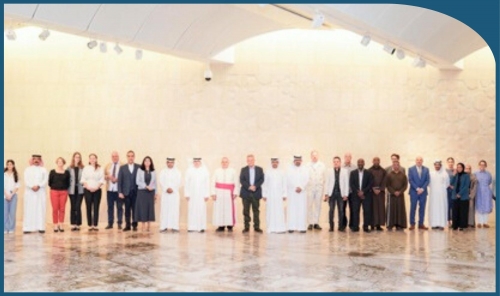
The Bahrain National Museum recently hosted a scientific seminar titled “Christian Archaeological Sites in Eastern Arabia: A Shared Heritage”, organized in collaboration with the King Hamad Global Centre for Coexistence and Tolerance. The event was attended by Dr. Salman Ahmed Al-Muharri, Director General of Antiquities at the Bahrain Authority for Culture and Antiquities, Abdullah Isa Al-Munaie, Executive Director of the King Hamad Global Centre for Coexistence and Tolerance, alongside several officials, archaeology enthusiasts, academics, and experts from both within Bahrain and abroad.
On the occasion, Sheikh Khalifa bin Ahmed bin Abdullah Al Khalifa, Chairman of the Bahrain Authority for Culture and Antiquities, emphasized that ongoing discoveries of Christian antiquities in the eastern Arabian Peninsula reflect the region’s cultural diversity, which serves as a positive pillar in its historical heritage. He noted that these archaeological sites highlight Bahrain’s rich civilization throughout the ages, positioning the Kingdom as a meeting point for civilizations and religions, with the Nestorian Christian heritage adding significant value to the region’s cultural diversity.
The first day of the seminar offered a historical overview of the Nestorian Christian heritage in eastern Arabia and reviewed efforts to preserve related archaeological sites. It included three main sessions: the first covered the Christian archaeological sites discovered in Samaheej, Bahrain, highlighting the site’s importance and preservation measures, alongside a presentation on the Qusur site on Kuwait’s Failaka Island and a summary of previous research and recent excavation results.
During the first day, a research paper on Christian archaeological discoveries on Sir Bani Yas Island was presented, addressing recent excavation outcomes and site preservation methods. Another study titled “From Late Antiquity to Early Islam: The Pearl City and the Christian Monastery on Sinniya Island – Umm Al-Quwain” examined the settlement and monastery as one of the Gulf region’s most notable recent discoveries.
The second session featured a discussion on historical links between the Arabian Peninsula and cross-regional Christian heritage, with reflections on the Arab context. The third session included expert presentations, including a paper on the church and monastery on Bani Yas Island, followed by a review of the current state of the ancient Christian monastery and strategies to preserve its historical and architectural significance. Additionally, the session examined successive civilizations on Failaka Island and approaches to managing and preserving the Samaheej archaeological site.
On the second day, three main discussion sessions were held. The first focused on the global significance of these sites, while the second addressed knowledge gaps and research needs for Christian antiquities in the Gulf region. This included two segments on research tools and documentation, as well as regional research frameworks and opportunities for capacity building in cultural heritage.
The third session concentrated on a regional cooperation plan for heritage preservation, future steps to enhance the historical and cultural importance of Nestorian Christianity in eastern Arabia, and key seminar outcomes and recommendations.
The program also featured a field visit to the Samaheej archaeological site in Muharraq, believed to be among the oldest Christian structures in the Gulf region, containing a collection of early Christian symbols.
Related Posts