

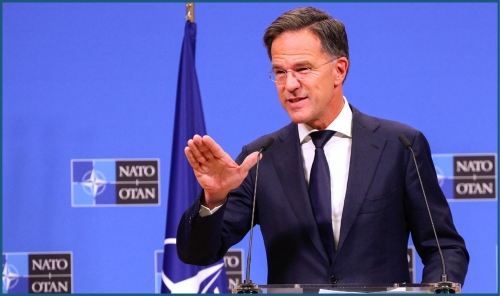
22 Nations Unite to Secure Strait of Hormuz: NATO Chief
Assesses Iran Missile Threat, Backs U.S. Strategy Amid Rising Tensions
NATO Secretary General Mark Rutte said the alliance is still assessing Iran’s missile capabilities after reports that Tehran launched missiles toward Diego Garcia, a joint U.S.-UK military base in the Indian Ocean.
Speaking in an interview on Face the Nation with Margaret Brennan, Rutte stated that NATO could not yet confirm whether the missiles used were intercontinental ballistic missiles capable of striking major European cities such as Berlin, Paris, and Rome.
“If true, it would indicate Iran already has long-range strike capability. If not, we know they are very close,” Rutte said.
He emphasized that Iran’s potential combination of nuclear and ballistic missile capabilities would pose a significant threat not only to Israel but also to Europe and global stability.
Rutte voiced support for U.S. efforts to weaken Iran’s military capabilities, describing such actions as “crucial” to preventing further instability in the region.
Global Coalition Forms Around Hormuz Security
The NATO chief revealed that 22 countries, including several NATO allies and partners such as Japan, South Korea, Australia, New Zealand, Bahrain, and the UAE, are coordinating efforts to secure maritime routes in the Strait of Hormuz.
The initiative aims to ensure safe navigation through the critical oil transit chokepoint, following rising tensions in the region.
Rutte noted that military planners are currently working on timelines and operational details, particularly in response to calls from Donald Trump to safeguard global energy flows.
Trump Criticism and NATO Response
The interview comes amid criticism from President Trump, who recently described NATO as a “paper tiger” without U.S. support and questioned the alliance’s commitment.
Rutte acknowledged the concerns but stressed that coordination among allies takes time, especially when initial military plans cannot be widely shared for security reasons.
He pointed to growing defense commitments among NATO members, including agreements to increase spending to 5% of GDP, as evidence of stronger transatlantic cooperation.
Balancing Iran, Russia, and Ukraine
Addressing broader geopolitical concerns, Rutte said the U.S. is balancing multiple priorities, including the war in Ukraine and tensions with Russia.
He noted that Washington continues to work with European allies to support Volodymyr Zelenskyy while also attempting to pressure Russia into negotiations.
Rutte added that President Trump’s diplomatic engagement, including outreach to Russian President Vladimir Putin, has been central to efforts aimed at ending the conflict.
Despite concerns over U.S. policy decisions, including easing restrictions on Russian oil exports, Rutte maintained that efforts to bring the Ukraine war to a close remain a top priority.
Related Posts