

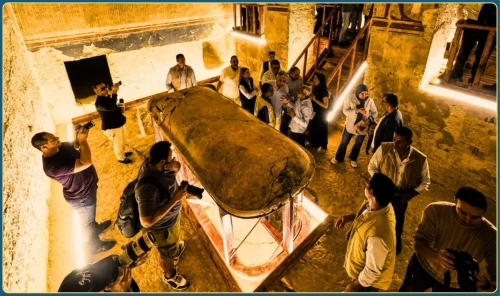
After Two Centuries, Tomb of Pharaoh Amenhotep III Opens to the Public
The tomb of Pharaoh Amenhotep III, one of the grandest and most historically significant burial sites in the Valley of the Kings, officially opened its doors to visitors on Saturday—more than 200 years after its discovery.
Carved over 3,000 years ago into the side of a hill on the west bank of the Nile, across from modern-day Luxor, the tomb is renowned for its stunning wall paintings—described by UNESCO as among the “most beautiful murals of Egypt’s 18th Dynasty.”
However, time and environmental damage had placed the ancient structure at serious risk of collapse. Before the recent restoration, the tomb’s walls showed extensive deterioration. The complex restoration project was completed with funding from the Japanese government and UNESCO.
The tomb was first discovered in 1799 by French archaeologists during Napoleon Bonaparte’s campaign in Egypt.
Amenhotep III—also known by his Greek name, Amenophis III—ascended the throne as a teenager and ruled for nearly four decades before his death around 1349 BC at the age of 50.
Located within the ancient Theban necropolis, the royal burial site lies among the tombs of kings, priests, and royal scribes dating back to between the 16th and 11th centuries BC.
Despite repeated looting throughout history, much of the tomb’s treasures were uncovered by French and British archaeologists in 1799 and 1915. Many of the funerary statues found there are now displayed in world-famous institutions such as the Louvre Museum in France, the Metropolitan Museum of Art in the United States, and Highclere Castle in Britain.
Today, Amenhotep III’s mummy and sarcophagus are housed in the National Museum of Egyptian Civilization in Cairo. His colossal seated statues with Queen Tiye can be admired at the Egyptian Museum in Tahrir Square and the Grand Egyptian Museum near the Giza Pyramids.
Near the tomb stands the magnificent temple of Kom el-Hetan, also commissioned by Amenhotep III. Although partially damaged by Nile floods, the site remains home to the iconic Colossi of Memnon—two towering granite statues that continue to captivate tourists and archaeology enthusiasts from around the world.
Related Posts