

The Art of Understanding...
TDT | Manama
Email: mail@newsofbahrain.com
I couldn't believe my eyes when I first saw the video. I looked again. And then once more.
A Bahraini fisherman was in the sea, seemingly riding alongside a shark. To most of us, the sight is frightening — a shark is one of the ocean's most efficient predators, its instincts and senses honed over millions of years. Yet here was a man completely at ease in its presence.
Perhaps he understood the animal's behaviour better than most of us ever could, knowing exactly when to approach and when to keep his distance. Either way, it was a memory that would stay with him for life.
It reminded me how little we really know about the sea. We have explored only a fraction of our oceans, yet beneath the surface exists an extraordinary world of intelligence, communication, instinct and survival.
One creature that fascinates me most is the orca.
Orcas are the largest members of the dolphin family and are apex predators that are remarkably intelligent, with sophisticated social structures. They have distinct hunting techniques, diets, and calls and clicks passed down through generations.
In some ways, their societies feel surprisingly familiar. Female orcas can live for decades after they stop reproducing, and scientists believe these older females play a vital role — helping younger members locate food and navigate difficult conditions, their accumulated knowledge becoming a survival tool for the whole family. In an ocean where survival depends on intelligence, cooperation and experience, knowledge passes down through generations.
Orcas also have a particular fascination with sharks, with some populations targeting the nutrient-rich livers and leaving much of the rest untouched.
And despite their fearsome reputation, there is no established pattern of wild orcas hunting humans for food. The nickname “killer whale” says more about their power as predators than about their relationship with us.
Perhaps the greatest lesson here is that instinct does not always mean aggression — it means understanding the environment well enough to survive within it.
I have swum in beautiful seas across many countries — the Maldives, Zanzibar, Langkawi. Yet I have always regretted not properly exploring the Andaman and Nicobar Islands, despite their relative closeness to my hometown in India.
A photographer friend once showed me images from his travels through those islands — among them, North Sentinel Island, home to the Sentinelese, one of the world's few remaining uncontacted Indigenous peoples.
For thousands of years, they have lived in remarkable isolation. Their population isn't known with certainty, but is thought to be small. They hunt, fish and gather using traditional methods, and have consistently made clear they want no contact with outsiders.
Their isolation isn't simply a matter of choice — it's a matter of survival. The Indian government strictly protects North Sentinel Island, recognising that people cut off from the modern world for generations may have little or no immunity to diseases ordinary to us, where even a mild infection could be devastating.
In 2018, American missionary John Allen Chau illegally travelled to the island attempting contact, and was killed — a tragic reminder of the danger of ignoring those boundaries. The story is disturbing, but it raises a difficult question: why do we assume every isolated community needs to be contacted, changed, or brought into our way of life?
This brings me back to the shark, the orca and the Sentinelese — at first seemingly sharing nothing: a predator, an extraordinarily intelligent marine mammal, and a human community deliberately separated from the modern world. Yet a common thread may run through all three.
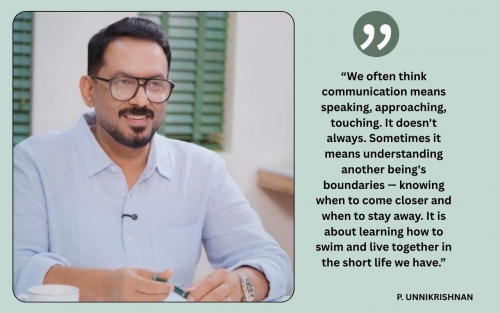
We often think communication means speaking, approaching, touching. It doesn't always. Sometimes it means understanding another being's boundaries — knowing when to come closer and when to stay away. It is about learning how to swim and live together in the short life we have.
(P.Unnikrishnan is the Chairperson and Managing Director of The Daily Tribune.)
Related Posts