

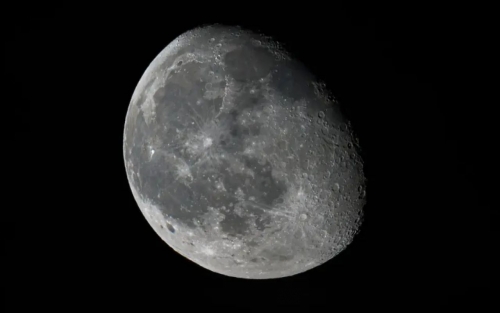
NASA invited India to the Moon – India invited the world instead
TDT | Manama
Email: mail@newsofbahrain.com
Washington has made India an eye-catching offer: help build NASA's permanent base on the Moon. The invitation was first extended at an India-US civil-space meeting in Bengaluru in early August. Washington has since made the message much harder to miss. Speaking again in Bengaluru, US ambassador Sergio Gor this month said that NASA wanted India "by our side" as it returned to the Moon and established a permanent presence there.
The headlines made the choice sound binary: would India join an American Moon base or not? India's response is more revealing. New Delhi is asking a different question: if it participates, what does India gain – and how much influence will it have over what comes next?
That matters hugely because a permanent lunar presence is not simply another science mission. It is infrastructure. Countries involved early could influence technical standards, data access, safety practices and eventually how resources and facilities are used and shared. But there is a clear downside: they could also be expected to spend heavily while remaining junior partners in an architecture designed elsewhere.
So far, India has not accepted NASA's invitation, announced earmarked funding or identified a specific hardware contribution. At the Bengaluru India-US Civil Space Joint Working Group, the two sides instead agreed to deepen cooperation in science, human spaceflight and open scientific-data sharing under the Artemis Accords. That caution characterises India's wider space strategy. V. Narayanan, Chairman of the Indian Space Research Organisation (ISRO), argued explicitly that international partnerships, private companies, start-ups and universities will all be of crucial importance if India is to lift its roughly 2% share of the global space economy towards 8%. But expanding the commercial sector is not intended to shrink ISRO. Narayanan insisted that the agency will not be privatised; instead, Indian industry is expected to take on more manufacturing and mature technologies, freeing ISRO to concentrate on exploration, strategic missions and the frontier capabilities that India intends to keep firmly in national hands.
The message for international partners is similar. India wants cooperation, but not if that cooperation hollows out the sovereign core of its own program. Recent US partnerships illustrate both the attraction and the limits. The NASA-ISRO Synthetic Aperture Radar (NISAR) is genuine co-development: each side contributed major radar systems to a shared Earth-observation mission. The Axiom-4 mission gave Indian astronaut Shubhanshu "Shux" Shukla operational experience aboard the International Space Station before India's own Gaganyaan crewed flights.
But neither automatically provides a model for a Moon base. The real test is what remains in India after a partnership ends: trained people, design expertise, industrial orders, intellectual property or influence over future decisions.
Prime Minister Narendra Modi sharpened that point in a video address at the International Space Summit in Paris this month. After restating India's goals of building its own space station by 2035 and putting an Indian astronaut on the Moon by 2040, he invited France and other countries to become "co-travellers in India's next space frontier". The direction of the invitation had suddenly reversed. India was no longer simply being asked to enter an American program; it was inviting partners into an Indian one.
Modi also stressed international law, multilateralism and open scientific data. That was not merely diplomatic language. ISRO has already taken a leading role in Artemis discussions on open scientific data, helping turn a broad principle into practical questions about interoperability, archives, reproducibility and access. That is where India's influence may begin to matter most. Shaping the emerging lunar order will not come only from supplying hardware; it will also come from establishing the rules.
Washington is not India's only space partner: New Delhi is also deepening cooperation with France and Australia. And at the recent BRICS summit in New Delhi, leaders backed further development of the BRICS Remote Sensing Satellite Constellation and noted progress towards a proposed BRICS Space Council. It is not an alternative BRICS Moon program. But it is another reminder that India is keeping several diplomatic tracks open at once. It points to a larger point: Indian space diplomacy cannot be reduced to alignment with Washington.
India is not coming to the table empty-handed. Chandrayaan-3 landed and operated near the lunar south pole, the region currently attracting most attention for sustained exploration. Yet neither NASA nor ISRO has explained whether India's measurements, landing experience or engineering lessons would feed directly into a future base.
India could participate by degrees. Open-data rules, astronaut training, docking standards and interoperability offer ways to shape the architecture before committing major hardware. Later involvement could extend to instruments, communications, habitats or surface systems, but only if those contributions accelerate Gaganyaan, the Bharatiya Antariksh Station and India's own crewed lunar ambitions.
Partnerships are one step. The test is who designs, builds, owns and operates the resulting capability, and who helps write the rules. India's caution is not indecision. It is an attempt to convert collaboration into autonomy: gaining technology and experience without becoming permanently dependent and helping shape the future of the Moon without surrendering control of its own destination.
(The views and opinions expressed in this article are those of the author and do not necessarily reflect the official policy or position of the Daily Tribune)
Related Posts