

When Trust Doesn’t Take Off
TDT| Manama
Email:online@newsofbahrain.com
Like many Indians, I had great expectations when Air India was taken over by the Tata Group — one of India’s most respected business houses, known for integrity, values and professionalism. Many of us believed Air India would slowly regain its lost glory and once again become an airline Indians could proudly trust.
Unfortunately, my recent experience with Air India Express left me deeply disappointed. Instead of visible improvement, I saw poor communication, weak passenger handling, and worrying signs that passenger confidence is being taken for granted.
Air India may no longer be under government control, but for millions of Indians, especially expatriates, the name still carries emotion. For many of us living abroad, Air India is still connected to India’s image and identity. That is why the disappointment hurts more.
During the recent regional tensions, many Gulf-based Indians were anxious about travel. Some had emergencies, family commitments, medical needs and urgent reasons to fly. At such a time, one would expect Air India and Air India Express to respond with urgency and sensitivity. Sadly, many passengers felt that this did not happen.
For someone like me, travelling to Kannur, Air India Express is often the only direct option. That makes reliability not just a matter of convenience but a necessity. Over the years, I have often felt that passengers travelling to India, especially to Kerala, are given aircraft that look tired and poorly maintained.
I had booked my Air India Express flight for 16 June, scheduled to depart at 23:35. To my surprise, I first received a message saying the flight was cancelled and rescheduled to 17th. Later, when I was almost prepared to leave for the airport, I received another message with a different timing. For an airline, this may be a routine schedule change. For a passenger, it is stress, confusion and uncertainty packed into one message.
My anxiety was also increased by a recent Air India Express incident involving a Kannur–Jeddah flight on 16 June 2026. Reports said the aircraft returned safely to Kannur after pilots detected an engine warning, with over 180 passengers on board. Thankfully, everyone was safe. But for ordinary passengers, such news naturally shakes confidence.
My concern is not only about delays or cancellations. It is also about what passengers see and feel after entering the aircraft.
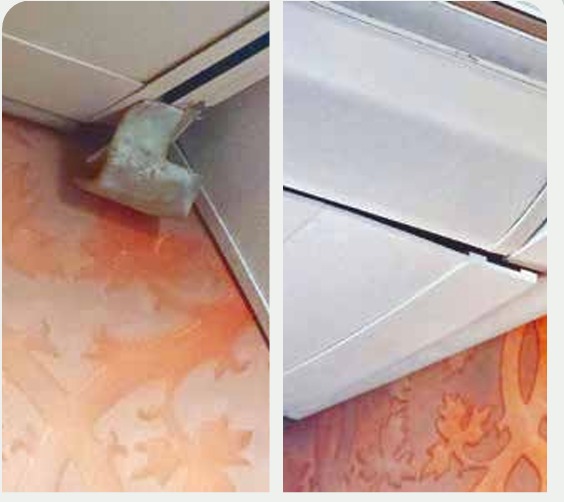
On my recent flight, when I sat down and looked up, I noticed a visible gap near the overhead luggage area. One side appeared to be slanting downward. In front of a passenger seat, I also saw what looked like a metal piece hanging awkwardly. I do not know whether it was technically unsafe or harmless, but visually it looked careless and unprofessional.
In aviation, appearances matter. Passenger confidence depends not only on actual safety, but also on visible discipline. A cabin that looks neglected can easily make passengers wonder what else is being ignored.
This does not mean every technical issue should create panic. Aviation is highly regulated, and aircraft sometimes return or divert as a safety precaution. But when passengers repeatedly hear about technical problems, cancellations, rescheduling and visible cabin neglect, trust begins to weaken.
Air India and Air India Express must understand one truth — aviation is built on trust. A passenger may forgive an occasional delay. A passenger may accept a technical return if it is handled professionally. But poor communication, visible neglect and repeated concerns together can deeply damage confidence.
Air India was once a matter of pride. Many of us still want it to be. But pride cannot be demanded from passengers. It must be earned again — flight by flight, cabin by cabin and passenger by passenger.
(P. Unnikrishnan is the Chairperson and the Managing Director of The Daily Tribune)
Related Posts