

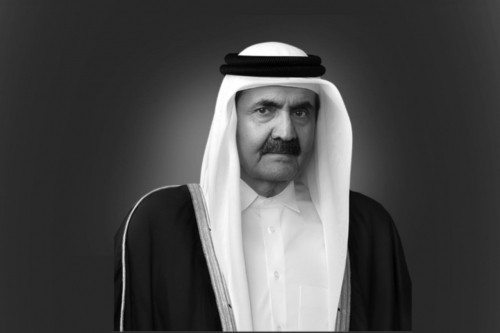
Father Amir: The Man Who Reimagined Qatar
TDT | Manama
Email: mail@newsofbahrain.com
"As the famous writer Abbas Mahmoud Al Aqqad said, 'A genius sews his own garments. A genius cannot be made by others.' The genius or the leader is self-made."
These are the opening words of a documentary on the late Shaikh Hamad bin Khalifa Al Thani, the former ruler of Qatar, who passed away on Sunday, 12 July 2026.
His genius, or leadership, becomes clear as you hear the interviews and recollections of his childhood friends, and his government's ministers and administrators.
The remarkable transformation of Qatar, under this late luminary—who was fondly called "Father Amir" after he abdicated the throne in 2013 in favour of his fourth son—is well celebrated by this poignant 2023 documentary titled Ode to Our Land.
The transmutation of Qatar from a pearling and fishing nation into an ultra-modern, globally connected economic powerhouse occurred under his leadership.
The metamorphosis of Doha from a coastal city into a global metropolis—one that embraces stunning avant-garde architecture without abandoning its deep-rooted Arab heritage—is another example of his insightful leadership.
On several fronts, he led the rapid growth of the Qatar peninsula, itself part of the broader Arabian Peninsula, which was also keeping pace.
In the energy sector, Qatar expanded its liquefied natural gas (LNG) production, making it the world's richest country per capita (in most of 2010s) and one of the world's largest LNG exporters. In global media and soft power, it launched the Al Jazeera Media Network in 1996, giving Qatar a powerful international voice.
In education and culture, the Qatar Foundation and Education City brought branch campuses of elite global universities to Doha, including Carnegie Mellon, Georgetown, Northwestern, Texas A&M, and Weill Cornell Medicine.
In the sporting arena, Qatar placed itself on the global athletic map by launching the annual Qatar Open Tennis tournament, hosting the 2006 Asian Games, and winning the 2010 bid to host the 2022 FIFA World Cup. By staging the tournament successfully, it brought the world to its doorstep.
In diplomacy, the country was positioned as an international mediator in complex regional conflicts, including those in Lebanon, Sudan, and Palestine. The establishment of Al Udeid Air Base to deepen strategic U.S. defence ties was another example.
On the economic investment front was the founding of the Qatar Investment Authority (QIA) in 2005 to manage and invest the country's massive reserve funds globally. Today, QIA is successfully transforming Qatar's finite hydrocarbon wealth into a diversified, globally influential sovereign wealth fund worth more than US$600 billion, securing long-term economic stability and international soft power for future generations.
Interestingly, at a time when the wives of Gulf leaders rarely shared the public spotlight with their husbands, Shaikh Hamad and Shaikha Mozah broke with convention and emerged as a distinctive royal couple seen together at state visits, international summits, and global events.
In the documentary I watched, Qatar's former Deputy Prime Minister and Minister of Energy and Industry, Abdullah bin Hamad Al Attiya, who grew up alongside him, says, "I remember him from when I was five years old. I was his friend."
“He was born with a charisma that no one else has. Since he was a child, he was always a leader. He was strict with us in soccer, especially as captain."
On the late Father Amir's dream of hosting the FIFA World Cup in Qatar, Mohammed bin Hammam, the former Qatari football administrator, said: "I was shocked by the scale of (his) ambition. I asked myself, 'Could it really happen?' None of us imagined it would, but he did."
For us, his greatest monument is not Qatar's skyline, but its confidence. Qatar—and indeed the entire Arab world—can proudly call him one of its finest visionaries.
Related Posts