

250 Years: The US Experiment
TDT | Manama
Email: mail@newsofbahrain.com
One of the best things I did last month, I suppose, was booking a walking tour.
While in Washington D.C., although for a different reason, I decided I would spend one full morning touring the U.S. Supreme Court, the Library of Congress, and, in particular, the Capitol building, including its crypt and the rotunda.
Thanks to Jobert, our main tour guide, I now have a clear insider’s view of the Capitol which is, arguably, the world’s most powerful government building.
Its grand and imposing neoclassical architecture, its role as the active legislative heart of a global superpower, and its function as a universal, globally-recognized, symbol of representative democracy, makes it unique.
Its construction began on September 18, 1793, when George Washington laid the cornerstone. Sadly, however, he did not live to see the opening of this awe-inspiring building in the then-brand-new city named after him.
Rebuilt after the British burned it down in 1814, the current, heavily modified, Capitol building incorporates parts of the original structure. The earlier dome was wooden, while the current one is cast-iron.
The birth of the United States, however, was not in Washington D.C. It was in Philadelphia, Pennsylvania.
When, 250 years ago, the Declaration of Independence was signed on July 4, 1776, at the Pennsylvania State House—now known as Independence Hall—in Philadelphia, not all 56 signatories were present, but they eventually signed.
The United States Constitution then came into force in 1789, and remains the world's oldest written national constitution still in operation. The Bill of Rights, comprising the first ten amendments to the Constitution, was ratified by 1791 and still serves as a moral compass for law-makers.
While this constitution drew inspiration from earlier documents such as England's Magna Carta of 1215, it broke new ground by creating a durable framework built on federalism, checks and balances, and an independent judiciary.
The nation's founders deliberately turned to the ideals of the ancient Roman Republic when designing their new capital and its institutions. As the US Senate itself notes, they sought architecture that reflected the dignity of a republic in a world dominated by monarchies. The Capitol, with its sweeping columns and majestic dome, was intended to symbolize constitutional government and not imperial power.
History, however, offers a cautionary tale. Rome remained a republic for nearly five centuries before gradually giving way to empire. France, after its revolution, oscillated between republics, empires and monarchies before eventually settling into a stable republican system. Constitutions alone do not preserve democracies. Institutions endure only when citizens and leaders remain committed to them.
Dozens of countries have borrowed elements of the American constitutional model showing us that ‘written constitution’ matters. But even more important are the ‘values’ it seeks to protect: the rule of law, the separation of powers, accountability, and government by the consent of the governed.
Whether today's United States administration reflects the vision of the Founding Fathers depends largely on one's interpretation of current events. Some see a government adapting to twenty-first century realities. Others argue that expanding executive authority, growing bureaucracy, and increasing political polarization have taken the republic further from the founders’ original intent.
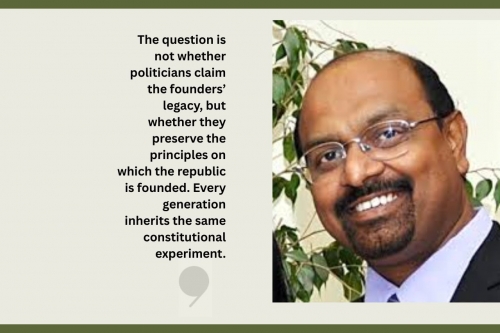
The question is not whether politicians claim the founders’ legacy, but whether they preserve the principles on which the republic is founded. Every generation inherits the same constitutional experiment. Every administration is merely its temporary steward.
As we concluded our tour, Jobert said something profound: "These buildings do not make the country great. It's the people inside them."
He was right. Marble columns, magnificent domes and historic chambers cannot defend democracy on their own. That responsibility rests with the lawyers and judges who interpret the law, the senators and representatives who debate and legislate, the presidents who exercise restraint, and ultimately the citizens who hold them all to account.
Great republics are not sustained by architecture. They are sustained by character.
(The views and opinions expressed in this article are those of the author and do not necessarily reflect the official policy or position of the Daily Tribune)
Related Posts