

Bahrainis take part in Arab Youth Survey
Manama : Arab youngsters reject Daesh (ISIS) and believe the group will not be able to succeed in its infamous mission, according to a survey conducted among the Arab youths in 16 countries in the Middle East and North Africa (MENA) by ASDA’A Burson-Marsteller.
But, the survey warns that the youth are worried about the lack of employment opportunities available and blame it for the rise of evil networks in the region.
The survey included 200 respondents from Bahrain, among 3500 respondents in the region.
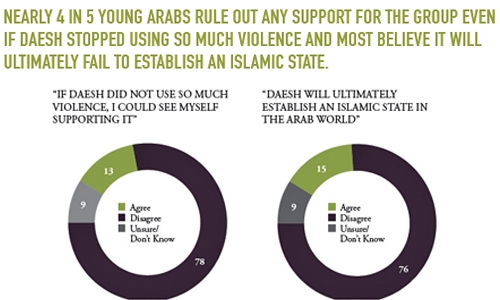
Even though ISIS is seen to be not winning in the long run, the respondents were worried about its rise. “While three in four (77 pc) Arab youths are concerned about the rise of Daesh, just one in six (15 pc) believe the terrorist group will ultimately succeed and establish an Islamic State in the Arab world,” the survey said.
Interestingly, youngsters of the region reject ISIS even without their infamous violence.
“Nearly 4 in 5 young Arabs rule out any support for the group even if Daesh stopped using so much violence. Most of them believe it will ultimately fail to establish an Islamic State,” notes the report.
Lack of jobs is helping such groups to recruit youngsters, according to 24pc of the respondents. Another 25pc are clueless why anyone would want to join the militant group.
The study said “Concern about lack of job opportunities remains an issue across the 16 countries polled with fewer than half (44 pc) agreeing with the statement that there are good job opportunities in the areas they live in.”
“Many people in the region may reject Daesh due to its extreme tactics, but the issue remains that the group exploits existing problems. It did not simply invent the problems the responders identified as factors. Daesh, put another way, is a symptom of a growing disease that needs to be tackled, and not just the disease itself,” according to Hassan Hassan, a resident fellow at the Tahrir Institute for Middle East Policy, in Washington DC, and associate fellow at the London-based think tank Chatham House.
“So, the solution to Daesh must not be limited to military and security responses. The organisation thrives on political, economic, social and religious failures. Daesh may weaken and disappear, but the underlying sickness will remain and similar groups will emerge if that sickness is not addressed. The Survey’s findings should be a reminder to everyone that Daesh did not simply materialise out of thin air,” warns the study.
Related Posts