

Worst since 2nd World War
H.E. Shaikh Salman: ‘economic terrorism’ could shake global trade
TDT | Manama
Email: mail@newsofbahrain.com
After 40 days of sustained missile and drone attacks that rattled regional security and disrupted global supply chains, Bahrain’s Finance Minister warned that the crisis now poses the most serious threat to international trade since the Second World War.
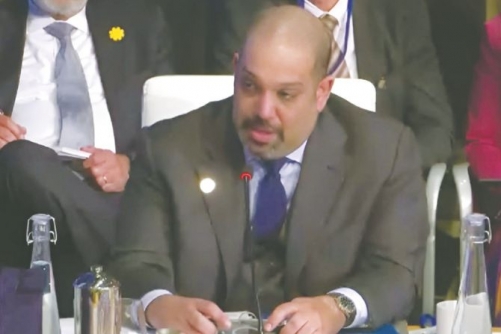
Speaking at the Spring Meetings of the World Bank Group and the International Monetary Fund, H.E. Shaikh Salman bin Khalifa Al Khalifa described what he called an unprecedented wave of attacks targeting Gulf Cooperation Council nations and the Kingdom of Jordan.
He said the assault lasted “40 days and 40 nights,” involving more than 5,000 missiles and drones, with over 1,000 launched within the first 24 hours alone. According to the minister, the strikes—attributed to Iran—targeted both civilian and strategic infrastructure.
“Residential areas, educational institutions, commercial buildings, airports, ports, power plants, oil and gas infrastructure, and other critical facilities were hit,” he said, noting that the attacks resulted in loss of life, injuries, and extensive damage.Despite the scale of the assault, Shaikh Salman praised the response of national institutions and the resilience of citizens and residents. “Today, we stand strong, proud of our armed forces, our security and civil defence institutions, and our communities,” he said.
He also acknowledged the support of international partners, expressing gratitude to regional allies as well as the United States and other global partners for standing “shoulder to shoulder” in defence of the region.
Turning to global implications, the minister issued a stark warning over maritime security, particularly any attempts to disrupt the Strait of Hormuz. He described such actions as “economic terrorism,” stressing that the waterway carries more than 20 per cent of the world’s oil and liquefied natural gas, along with significant volumes of aluminium and fertiliser exports.
He cautioned that any prolonged disruption could trigger the largest shock to global supply chains in decades.
Highlighting diplomatic developments, Shaikh Salman pointed to the adoption of United Nations Security Council Resolution 2817, calling it a “historic” step that sends a clear international message.
He urged a coordinated global response to the unfolding crisis, calling for stronger international cooperation to address both security and economic risks.
The minister also stressed the need to advance broader regional diplomacy, including efforts towards a durable ceasefire in Lebanon and improved humanitarian conditions in Gaza. He framed the situation as a defining moment for the international community.
“This is a conflict between those who seek a peaceful and prosperous future and those who seek to drag the region backwards,” he said.
Reinforcing the urgency of the moment, Shaikh Salman called on global institutions to step up support. “We call on the World Bank and the international community to support us,” he added, underscoring the need for sustained cooperation to restore stability.
Related Posts