

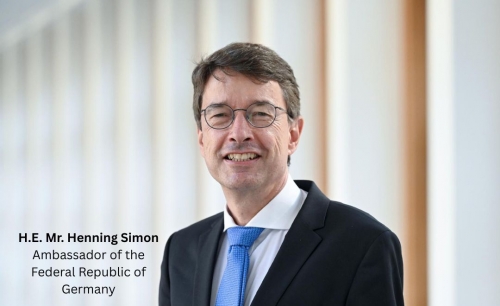
Germany warns of ‘power politics’
TDT | Manama
Email: mail@newsofbahrain.com
As the international community moved into 2026, profound structural shifts are testing the foundations of the rule-based global order. One of the most significant trends influencing international relations is the growing tension between cooperation and fragmentation. While global challenges increasingly transcend borders, the willingness of some actors to uphold shared rules and norms has come under strain, testing the resilience of the international system built over decades. The international environment is increasingly characterized by strategic rivalry, selective engagement with international norms, and a growing tendency to subordinate shared rules to narrow national interests.
In this respect, dialogue and negotiation remain indispensable, yet they are too often overshadowed by coercive approaches that prioritize leverage over legitimacy. When power is exercised without regard for commonly agreed principles, trust erodes and the predictability necessary for stability diminishes. Traditional state-to-state diplomacy remains essential, yet it is complemented by more complex forms of dialogue involving cities, private actors, and civil society. At the same time, diplomacy is becoming more transactional and, in some cases, more confrontational, reflecting a perception among certain powers that influence can be maximized through pressure rather than consensus.
Economic cooperation is also undergoing transformation. Global supply chains are being reassessed in the name of resilience, but this trend carries the risk of deepening divisions if it leads to exclusion rather than diversification. Sustainable growth will depend on maintaining open markets, fair competition, and respect for agreed frameworks that ensure mutual benefit rather than unilateral advantage.
Our common task for this year must be to protect multilateralism. Global expectations are shifting toward greater accountability, inclusiveness, and effectiveness from international institutions. Preserving a rules-based international order requires renewed commitment, restraint, and good faith from all states, regardless of size or power.
Against this background, the Federal Republic of Germany will continue to cooperate closely with the Kingdom of Bahrain to uphold the international rule-based order, peace and tolerance around the globe and commends Bahrain’s vital role in the United Nations Security Council For Germany, foreign policy remains firmly guided by the interlinked principles of peace, security, and prosperity—principles that can only be sustained through respect for international law, responsible state behavior, and genuine multilateral cooperation.
As 2026 begins, the central question is whether states will recommit to collective responsibility—or continue down a path where power increasingly substitutes for principle.
Related Posts