

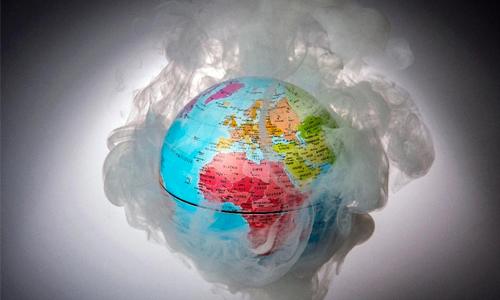
Humanity's future in the balance at UN climate summit
In two weeks' time, world leaders gather for a crunch climate summit in terror-hit Paristo determine what kind of future awaits humankind.
Security fears threaten to overshadow the conference to be launched by some 120 heads of state after a coordinated spree of attacks by gunmen and suicide bombers killed 129 people in the French capital.
But US President Barack Obama has stood firm in his resolve to attend the November 30 opening, and France insists it won't bend a knee to terrorism by postponing the event.
After all, the stakes are high.
Will we succeed in containing greenhouse gas emissions altering Earth's climate? Or will we overshoot the critical warming level beyond which science says our planet could become inhospitable to humans?
The answer will be determined by what emerges from the November 30-December 11 haggle.
The conference represents the first bid for a truly universal climate rescue pact since the chaotic 2009 summit in Copenhagen ended in bitter disappointment.
Much has changed since then: evidence has accumulated for the planetary perils we face; low-carbon technology has become cheaper and more readily available; and political, business and public pressure for a future powered by renewable energy has gained momentum.
At the same time, the window of opportunity for action has narrowed.
Just last week, Britain's weather office said Earth has already heated by about 1 C -- halfway to the UN target of limiting average global warming to two degrees Celsius (3.6 Fahrenheit) above pre-Industrial Revolution levels.
The World Meteorological Organization says greenhouse gas levels in the atmosphere hit a new record in 2014.
"We have a dramatic increase in the extreme weather events connected to climate," former US vice president and Nobel-awarded climate activist Al Gore told AFP last week.
"We're seeing sea level rise (to) now flood the streets of many cities during high tides. We're seeing refugee crises that have multiple causes, but we know they are made worse by, for example, the historic climate-related drought in Syria.
"There is a need, for multiple reasons, to stabilise the climate and stop disrupting it."
The Paris conference was meant to be preceded by a mass rally in the city on November 29 to prod political leaders into action, but security concerns mean that is now at risk.
The conference itself will gather some 40,000 delegates, journalists, observers and exhibitors, and France has said security forces will focus their attention there.
There will be more than a hundred speeches at the start of the summit, with some political star power set to grab the world's attention.
China's Xi Jinping, Narendra Modi of India and Russia's Vladimir Putin had all confirmed their attendance prior to the November 13 Paris attacks.
After the opening, rank-and-file diplomats will have a week to produce a draft of the deal to be finalised and signed by environment ministers.
As it stands, the 55-page blueprint negotiated over the last six years is little more than a wish list of individual nations -- many of them contradictory -- for dealing with the challenge at hand.
Many fear this may be our last stab at producing a negotiated plan for ensuring Earth remains hospitable to humans.
Japanese climate negotiator Aya Hoshida told AFP: "If we fail... it will be very difficult to create the same type of momentum and a sense of urgency to adopt this agreement."
Photo Caption: Terror-hit Paris will be hosting world leaders for a crunch climate summit from November 30 to December 11, 2015
Related Posts