

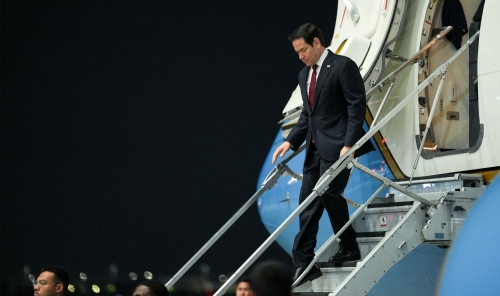
Rubio begins Gulf tour as Hezbollah demands timed Israeli withdrawal
US Secretary of State Marco Rubio has begun a Gulf tour aimed at reassuring regional allies following recent developments in the Middle East, as Hezbollah’s leadership renewed calls for a full Israeli withdrawal from southern Lebanon under a defined timetable.
Speaking at the start of his visit in Abu Dhabi, Rubio said no country has the right to impose tolls or fees on the Strait of Hormuz, stressing that the waterway remains subject to international law. His comments come as reports suggest Iran is seeking to generate revenue from maritime passage through the strategic chokepoint.
“It’s an international waterway. No country is allowed to charge tolls or fees on an international waterway. That’s existing international law,” Rubio said upon arrival. He added that regional governments were likely to agree with the US position.
Rubio also warned that long-term stability in the Middle East remains out of reach while armed groups continue cross-border attacks.
“You can’t have the end of hostilities and conflicts in the region as long as Iranian proxies are launching missiles and drones from Iraq,” he said, referencing groups he linked to attacks involving Hamas and Hezbollah.
His Gulf tour includes meetings in the United Arab Emirates, Kuwait, and Bahrain, where he is expected to attend a Gulf Cooperation Council (GCC) meeting focused on regional security and post-conflict stability following a US-Iran agreement aimed at reducing wider tensions.
Hezbollah demands Israeli withdrawal timetable in Lebanon
Separately, Hezbollah leader Naim Qassem has called for a full Israeli withdrawal from Lebanese territory under a clear timetable, following what he described as a ceasefire arrangement linked to broader regional de-escalation efforts.
“We now have a ceasefire. The withdrawal must take place according to a timetable,” Qassem said in a televised address. He insisted that Israel must leave all Lebanese territory “without retaining an inch.”
Qassem added that once Israeli forces withdraw, the Lebanese army should be deployed exclusively south of the Litani River, signalling a return to state military control in the area.
His remarks come amid ongoing diplomatic efforts tied to a US-Iran understanding that seeks to reduce conflict across multiple fronts in the region.
Related Posts