

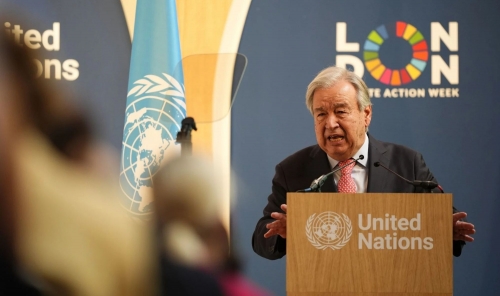
UN Chief Warns of “Tale of Two Crises” at London Climate Action Week
The United Nations Secretary-General has warned that the world is facing what he described as a “Tale of Two Crises” — an accelerating climate emergency and a deepening global energy shock driven by fossil fuel dependence.
Addressing leaders at London Climate Action Week, he said both crises share a common root: fossil fuels, and require a unified response centred on a “fast, fair transition” to clean energy alongside stronger climate adaptation and resilience measures.
“Crisis brings clarity,” he said, noting that the world is simultaneously confronting rising temperatures and instability in global energy markets.
Record Heat and Climate “Tipping Points” Raise Alarm
The UN chief highlighted that the planet has just experienced the eleven hottest years on record, warning that global temperatures are approaching dangerous thresholds.
He said the world is likely to temporarily exceed the 1.5°C warming limit agreed under the Paris Agreement, stressing the need to “limit the overshoot, shorten its duration, and bring temperatures back down as fast as possible.”
He warned of irreversible “tipping points,” including:
- Potential collapse of coral reef systems
- Accelerating ice loss in Greenland and West Antarctica, driving sea-level rise
- Disruption of ocean circulation systems
- Possible Amazon rainforest degradation
“The Earth’s tipping points are like objects in a car mirror — closer than they appear,” he said.
Energy Crisis Driven by Global Conflict and Fossil Fuel Dependence
The Secretary-General also pointed to a second global crisis: an energy shock triggered by conflict in the Middle East, compounded by reliance on fossil fuels.
He said the crisis is comparable in scale to historic oil shocks and is hitting developing nations particularly hard, leading to debt pressure, food insecurity, and economic strain.
“This model has no future,” he said, arguing that the world’s fossil fuel-based system is both economically fragile and environmentally unsustainable.
Call for a Rapid Shift to Clean Energy
Despite the challenges, he said the global transition to renewable energy offers a viable path forward.
He highlighted sharp cost reductions in clean technologies since 2010, including:
- Solar energy costs down nearly 90%
- Onshore wind down over 70%
- Battery storage down 95%
He noted that renewables are now cheaper than fossil fuels in most new electricity generation worldwide and are already attracting nearly twice the investment of fossil fuels.
“Energy independence cannot be built on fossil fuel dependence,” he said.
Seven-Point Plan for Climate Action
The UN chief outlined seven priority areas to accelerate the transition:
1. Stronger Emissions Cuts
He warned current national climate plans fall far short of what is needed, calling on the G20 — responsible for 80% of emissions — to take stronger action.
2. Methane Reduction Campaign
He launched a global call to cut methane emissions, describing it as a fast-acting lever for climate progress, especially in waste, agriculture, and fossil fuel production.
3. Energy Security Without Fossil Expansion
He cautioned against expanding coal, oil, and gas infrastructure, warning that new fossil assets risk becoming stranded and economically unviable.
He also urged governments to tax windfall fossil fuel profits and reinvest them into clean energy and vulnerable communities.
4. Modernising Energy Infrastructure
He called for urgent upgrades to electricity grids, storage systems, and regulatory frameworks to support large-scale electrification.
5. AI and Environmental Transparency
He proposed a new initiative requiring major artificial intelligence companies to disclose their environmental impact and commit to renewable-powered data centres by 2030.
6. Just Transition for Workers and Nations
He stressed the need for a coordinated global effort to manage the shift away from fossil fuels, ensuring fairness for workers, producing countries, and developing economies.
7. Climate Adaptation
He warned that adaptation is now essential as climate impacts intensify, with droughts, floods, and heatwaves already triggering cascading crises in food, health, and economies.
Warning Against “Business as Usual”
The UN chief criticised continued investment in fossil fuel expansion, calling it a “retreat” rather than leadership.
He said the benefits of the current system are unevenly distributed, while ordinary citizens face rising costs and insecurity.
“Working people are paying the price, while fossil fuel companies continue to reap extraordinary profits,” he said, urging governments to redirect windfall gains toward public benefit.
Related Posts