

US Launches ‘Project Freedom’ as Tensions Rise in Strait of Hormuz
US Defence Secretary Pete Hegseth calls Hormuz Mission temporary
Washington D.C.: The United States has launched a major military operation to escort commercial vessels through the Strait of Hormuz, as tensions with Iran continue to threaten one of the world’s most critical energy chokepoints.
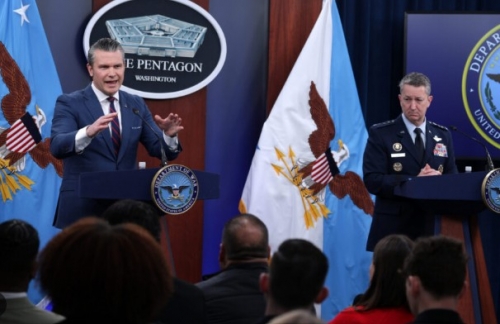
US Defence Secretary Pete Hegseth said the mission, named Project Freedom, is a temporary and defensive effort aimed at ensuring safe passage for hundreds of tankers and cargo vessels stranded in the Gulf following weeks of regional conflict.
“We’re not looking for a fight,” Hegseth told reporters, describing the operation as a defensive umbrella designed to keep global trade moving while preventing further escalation.
The mission comes after Iranian officials warned of possible escalation in the Strait of Hormuz, a narrow waterway through which nearly one-fifth of global oil and liquefied natural gas supplies pass during normal times.
Hegseth said recent US naval operations had shown that Iran does not control the strait, adding that American forces had successfully helped vessels begin moving through the corridor.
So far, two US-flagged merchant ships have exited the Gulf through sea lanes cleared of naval mines using robotic systems.
Gen. Dan Caine, the chairman of the Joint Chiefs of Staff, said Tuesday was quieter following Monday’s exchange of fire, during which US warships intercepted Iranian cruise missiles and drones targeting naval and commercial vessels under escort.
He also confirmed that US Army Apache helicopters sank six Iranian military speedboats that approached escorted vessels.
Caine said the United States has created a vast defensive network over the strait involving armed surveillance drones, fighter jets, attack helicopters, Navy warships, two aircraft carriers, and nearly 15,000 military personnel deployed across the region.
Despite the operation, US intelligence officials acknowledge Iran still retains thousands of missiles, drones, and armed speedboats capable of threatening maritime traffic.
Caine added that since the ceasefire began three weeks ago, Iran has launched more than ten attacks on US positions, though none have crossed what he described as the threshold for renewed large-scale combat.
The operation comes as oil prices remain above $100 a barrel, with global markets closely watching whether the fragile ceasefire between Washington and Tehran can hold.
Related Posts