

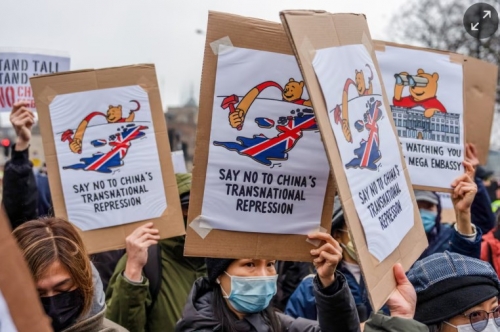
Global Surge in ‘Transnational Repression’ Alarms Rights Group
email: online@newsofbahrain.com
Washington: Authoritarian governments increasingly targeted their own citizens beyond national borders in 2025, with a notable rise in such activities in Southeast Asia and East Africa, according to a report released Thursday by Freedom House.
The practice, known as transnational repression, gained global attention after the 2018 murder of Saudi journalist Jamal Khashoggi at his country’s consulate in Istanbul.
In its annual assessment, Freedom House identified China as the leading perpetrator in 2025, followed by Vietnam and Russia. Six countries — Afghanistan, Benin, Georgia, Kenya, Tanzania and Zimbabwe — were newly added to the list of offenders.
This brings the total number of countries known to have engaged in such practices since 2014 to at least 54, according to report co-author Yana Gorokhovskaia.
The report documented 126 incidents in 2025, with more than half — 69 cases — occurring in Southeast Asia and East Africa. It highlighted growing cooperation among governments in these regions, including instances where countries allegedly exchanged dissidents to facilitate arrests.
Gorokhovskaia noted that such actions often intensify during periods of political or election-related pressure.
In one case, Ugandan opposition leader Kizza Besigye was reportedly abducted in Kenya in November 2024 and transferred to Uganda, where he faces treason charges. In another, Tanzanian activist Maria Sarungi Tsehai was kidnapped in Nairobi in January 2025 before being released following international pressure.
In Southeast Asia, the report said Thailand had faced pressure from China and Vietnam to return members of ethnic minority groups, amid concerns over potential economic repercussions.
The report also noted that immigration restrictions often keep dissidents within nearby regions, increasing their vulnerability. “This leads to more repression within what can be described as ‘authoritarian neighborhoods,’” Gorokhovskaia said.
Detention was the most common tactic recorded, accounting for 49 incidents, followed closely by unlawful deportations with 48 cases.
Freedom House urged democratic governments to impose sanctions and visa bans on foreign officials involved in such practices and to hold accountable authorities in host countries that enable these actions.
“Transnational repression is a low-cost way of maintaining control by suppressing dissent,” Gorokhovskaia said, adding that international responses are often short-lived.
She pointed to the global reaction following Khashoggi’s killing — widely linked to Saudi authorities — which, despite initial outrage, eventually gave way to normalized diplomatic relations.
Related Posts