

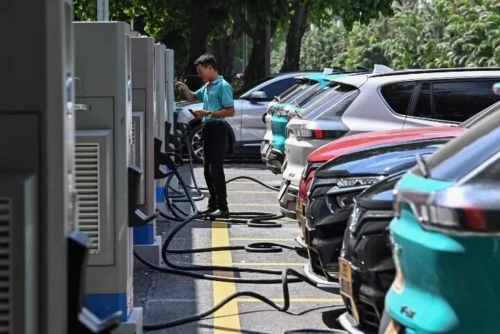
Fuel Crisis Accelerates Asia’s EV Shift
Email: online@newsofbahrain.com
The ongoing Middle East conflict has transitioned electric vehicles (EVs) from a niche market segment into a strategic economic alternative across Asia. As global crude oil prices exceed $100 per barrel, regional markets are seeing a significant shift in consumer behavior driven by record-high fuel costs and energy insecurity.
In the Philippines, authorities project diesel prices could reach ₱170 per liter if regional tensions persist. The government has already responded by suspending excise taxes on LPG and kerosene to mitigate the impact on households. This urgency stems from the disruption at the Strait of Hormuz, a critical chokepoint through which 20% of global seaborne oil and 80% of Asia-bound oil typically transit. Currently, an estimated 172 million barrels of petroleum products remain stranded at sea due to the conflict.
Industry data confirms that this energy crisis is acting as a massive catalyst for EV adoption. VinFast reported a 127% year-on-year sales increase in Vietnam for March, while a flagship showroom in Hanoi noted that over 50% of its customers switched from petroleum to electric vehicles in a single month. In Thailand, BYD secured the highest number of orders at the Bangkok Auto Show, marking the first time a Chinese EV maker has surpassed Toyota in that market.
Beyond Southeast Asia, the trend remains consistent. EV registrations in Japan and South Korea more than doubled in March, while India and Australia saw growth exceeding 50%. To keep pace with this momentum, manufacturers are aggressively scaling their international presence; BYD has revised its 2026 export target upward to 1.5 million vehicles. As traditional fuel becomes increasingly unsustainable for the average commuter, the pivot to electric mobility is becoming a permanent fixture of the Asian economic landscape.
Photo Credits: AFP
Related Posts