

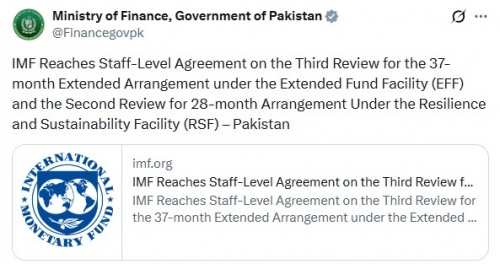
IMF reaches staff-level deal with Pakistan for $1.2bn disbursement
email: online@newsofbahrain.com
Islamabad: The International Monetary Fund on Saturday announced a staff-level agreement with Pakistan for the disbursement of about $1.2 billion, following the successful completion of the third review under the Extended Fund Facility (EFF) and the second review under the Resilience and Sustainability Facility (RSF).
Subject to approval by the IMF Executive Board, Pakistan will gain access to around $1.0 billion under the EFF and approximately $210 million under the RSF, bringing total disbursements under both programmes to about $4.5 billion.
The IMF said Pakistan’s programme implementation has remained broadly aligned with key objectives, including strengthening public finances, maintaining inflation within the target range of the State Bank of Pakistan, improving the energy sector’s viability, and advancing structural reforms.
The Fund also acknowledged progress on Pakistan’s climate reform agenda under the RSF, noting continued efforts to enhance resilience and reduce vulnerabilities to climate-related risks.
Talks between IMF officials and Pakistani authorities were held in Islamabad and Karachi from February 25 to March 2, followed by virtual discussions.
IMF mission chief Iva Petrova said ongoing policies have helped strengthen economic stability and rebuild market confidence, with inflation and the current account remaining contained while external buffers improved.
However, the IMF warned that ongoing tensions in the Middle East could impact Pakistan’s economic outlook, citing risks from volatile energy prices and tighter global financial conditions.
The Fund emphasised the need for Pakistan to maintain prudent fiscal policies, reduce public debt, and continue reforms to broaden the tax base and improve expenditure discipline. It also highlighted efforts to strengthen revenue collection through reforms at the Federal Board of Revenue, including digital invoicing and improved governance.
On social protection, the IMF noted plans to expand and strengthen the Benazir Income Support Programme to shield vulnerable households from rising food and fuel costs.
The central bank was urged to maintain an appropriate monetary policy stance, with flexibility in the exchange rate acting as a key buffer against external shocks.
The IMF also stressed the importance of reforms in the energy sector to address circular debt, including timely tariff adjustments and reducing reliance on subsidies, while promoting efficiency and renewable energy.
The agreement marks another step in Pakistan’s ongoing efforts to stabilise its economy and sustain growth through structural reforms and fiscal discipline.
Related Posts