

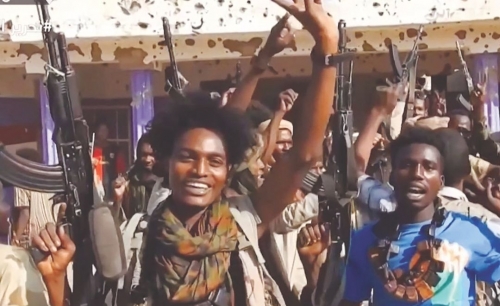
Survivors say Sudan’s RSF detains hundreds near El-Fasher
AFP | Port Sudan
Email : editor@newsofbahrain.com
A young man from one of the towns outlying the western Sudanese city of El-Fasher, Hussein was one of hundreds of men and boys captured and held by paramilitary forces that have overrun the area.
“We were rounded up and taken,” he told AFP on Sunday, explaining how he and roughly 200 other young men were detained for days by Rapid Support Forces (RSF) fighters in Garni, 25 kilometres northwest of El-Fasher, after they tried to flee.
“They hit us with sticks and called us ‘slaves’,” said Hussein, who asked to be identified only by his first name for fear of reprisal.
The RSF, at war with Sudan’s army since April 2023, seized the strategic city of El-Fasher one week ago, pushing the military out of its last stronghold in the region after an 18-month siege marked by starvation and bombardment.
Since the takeover, reports have emerged of executions, sexual violence, looting, attacks on aid workers and abductions in and around El-Fasher, where communications remain largely cut off.
Hussein said as well as being beaten and insulted, he and his fellow detainees were given only one meal a day.
“ They locked us inside a school building. After four days, they released some of us, but every day they brought in new people,” he said.
Darfur is home to several non-Arab ethnic groups, who form the majority of the population and have long been targeted by Arab militias.
The RSF traces its origins to the Janjaweed, a predominantly Arab militia accused of genocide in Darfur two decades ago. Reports since El-Fasher’s fall have raised fears of a return to similar atrocities.
‘Alive or dead’
The UN said more than 65,000 people have fled El-Fasher, including around 5,000 to nearby Tawila, but tens of thousands remain trapped. Before the final assault, roughly 260,000 people lived in the city.
“Where are all the missing people who have already survived months of famine and violence in El-Fasher?” asked Michel Olivier Lacharité, head of emergencies for Doctors Without Borders (MSF).
The numbers of new arrivals “don’t add up”, he said, while accounts of large-scale atrocities are mounting.
Satellite imagery analysed by Yale University’s Humanitarian Research Lab on Friday showed activity consistent with displaced people in RSF-controlled Garni.
The lab identified “multiple objects that measure approximately 2 metres x 3 metres” at a separate facility that may have been used as a school.
Among those detained was Abbas al- Sadek, a lecturer at El-Fasher University.
One of his relatives, who asked not to be identified for fear of reprisal, said that before his disappearance, the lecturer sent a short video pleading with a colleague to transfer $900 to a bank account.
In a video, seen by AFP, Sadek is heard to say: “This money is worth my life and they gave me a short time -- just 10 minutes.” The money is believed to have been a ransom payment, the relative said. Sadek was later released and is now on his way to Tawila.
Many others remain unaccounted for. Zahra, a mother of five who is sheltering in Tawila and also asked to be identified by her first name, told AFP that RSF fighters took her two sons, aged 16 and 20.
“They finally let the younger one go, but I don’t know if Mohammed is alive or dead,” she said, referring to her oldest son.
Related Posts