

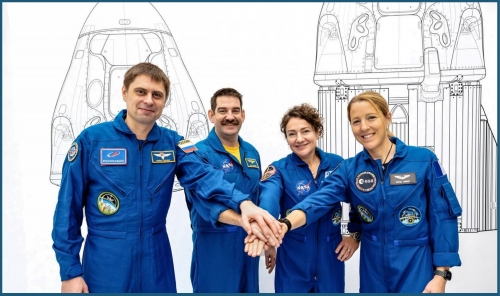
NASA Prepares SpaceX Crew-12 for Long-Duration Science Mission
NASA’s SpaceX Crew-12 mission is set to launch on a long-duration science expedition to the International Space Station (ISS), with astronauts taking part in a series of human health studies aimed at understanding how the body adapts to life in microgravity.
Led by NASA’s Human Research Program, the experiments will examine changes in blood circulation, balance, vision, and decision-making in space. The findings are expected to support planning for extended missions and future exploration of the Moon and Mars.
One of the key investigations, known as the Venous Flow study, will assess whether prolonged stays aboard the ISS increase the risk of blood clot formation. In weightless conditions, bodily fluids tend to shift toward the head, potentially altering blood flow and raising the risk of clots, which could lead to serious complications such as strokes.
“Our goal is to better understand how fluid shifts affect clotting risk so we can develop effective strategies to keep astronauts safe during long-duration missions,” said Dr. Jason Lytle, a physiologist at NASA’s Johnson Space Center and lead investigator of the study.
To support the research, astronauts will undergo MRI scans, ultrasound imaging, blood tests, and blood pressure measurements before and after the mission. During their time in orbit, crew members will also perform self-guided ultrasound scans of their jugular veins and collect blood samples for analysis upon return to Earth.
Another study, titled Manual Piloting, will focus on how astronauts adapt to changes in gravity that can cause spatial disorientation. Selected crew members will conduct simulated lunar landings before, during, and after the mission, testing their ability to manually pilot a spacecraft toward the Moon’s South Pole region — a key target for NASA’s Artemis program.
“Astronauts may experience disorientation during gravitational transitions, which can make tasks like landing a spacecraft more challenging,” said Dr. Scott Wood, a neuroscientist at NASA Johnson who is overseeing the study.
Although future Moon and Mars landings are expected to be largely automated, astronauts must be prepared to take control if needed. Researchers will analyze how well crews can override automated systems and whether targeted training late in a mission improves landing performance.
Additional studies will explore treatments for spaceflight-associated neuro-ocular syndrome (SANS), a condition that affects vision and eye structure. Researchers will test whether daily B-vitamin supplements can help reduce symptoms.
After returning to Earth, some crew members will also take part in post-landing injury assessments to document bruises or minor injuries sustained during re-entry. The data will be used to improve spacecraft design and safety measures for future missions.
Together, these studies aim to strengthen astronaut health and performance, ensuring crews are better prepared for long-duration spaceflight and upcoming missions beyond low Earth orbit.
Related Posts