

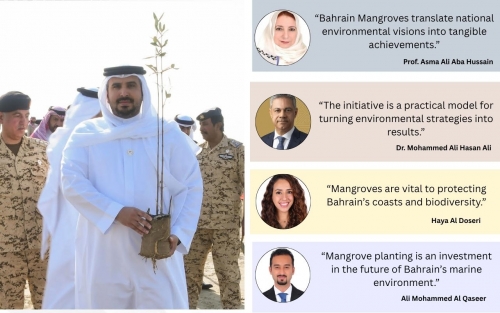
2.23 Million Mangrove Seedlings Planted
TDT | Manama
Email: mail@newsofbahrain.com
Experts hail the initiative as a sustainable investment in Bahrain’s environment and biodiversity.
Launched in December 2024 by His Highness Shaikh Mohammed bin Salman bin Hamad Al Khalifa, the initiative aims to quadruple the number of mangrove trees by 2035 and support Bahrain’s goal of achieving carbon neutrality by 2060.
Environmental experts said the initiative demonstrates Bahrain’s commitment to turning environmental strategies into practical results.
Professor Asma Ali Aba Hussain, Professor of Earth and Environmental Sciences and Head of the King Hamad Award for Agricultural Development judging panel, said mangroves are an important nature-based solution to climate change, helping absorb and store carbon while protecting coastlines and providing habitats for marine life and birds.
Dr. Mohammed Ali Hasan Ali, Chairman of the Public Utilities and Environment Committee at the Shura Council, said the initiative provides a practical example of translating national environmental strategies into measurable achievements.
He added that mangrove cultivation supports coastal ecosystems, biodiversity and climate resilience.
Environmental consultant Haya Al Doseri highlighted the initiative’s community value, saying it can strengthen public awareness and encourage greater participation in protecting Bahrain’s natural environment. She also pointed to the potential of mangrove areas to support ecotourism, marine activities and scientific research.
Ali Mohammed Al Qaseer, Chairman of the Board of Directors of Clean Up Bahrain Society, described the initiative as an investment in the future of Bahrain’s marine environment.
He stressed that its success should be measured not only by the number of trees planted, but also by continued community involvement in protecting and preserving them.
The experts also stressed the importance of continued cooperation between government bodies, the private sector, environmental organisations and civil society to ensure the initiative’s long-term impact.
Related Posts