

Hope After Medical Breakthrough
Bahrain’s first CRISPR bone marrow transplant patient shares recovery journey
TDT | Manama
Email: mail@newsofbahrain.com
Amjad Kazem Ahmed, the first Bahraini to undergo bone marrow transplantation using CRISPR gene-editing technology for sickle cell disease, is now navigating a new phase of life—one that lies between illness and full recovery, shaped by gradual progress, physical limitations, and renewed hope.
While much attention has been given to the medical milestone itself, Amjad’s story extends beyond treatment. It highlights the often-overlooked phase of transition, where recovery is not immediate, and rebuilding life takes time, patience, and resilience.
Speaking to The Daily Tribune, Amjad described his experience as physically and emotionally demanding. “The illness was extremely exhausting, and it had no specific timing… even the treatment period was difficult, but hope and positivity were stronger than the fatigue,” he said.
Living with sickle cell disease since childhood, a hereditary condition, meant that daily life was shaped by limitations. Simple activities such as swimming, running, or playing football were often out of reach due to the risk of triggering complications. “I was deprived of many things, because pushing myself could make me sick,” he added.
Now, Amjad finds himself in what he calls a transitional stage. “It’s a transition from illness to recovery,” he said, noting that while his condition has improved, his body is still regaining strength.
This phase is marked by a strong sense of enthusiasm to reclaim what was once lost, but also by moments of realization. “Sometimes I get excited to do things, but then I’m surprised that my energy doesn’t allow it,” he explained.
Determined to move forward, Amjad has begun focusing on rebuilding his physical strength.
“Right now, I’m training and strengthening my body so I can do the things that sickle cell once prevented me from doing.”
The illness's impact extended beyond physical health, affecting his academic journey as well. “Even in my studies, I’ve become more ambitious… the illness affected me and delayed me significantly,” he said.
Throughout his treatment journey, Amjad expressed deep appreciation for the medical team, emphasizing their continuous care and dedication. He noted that their support played a significant role in helping him navigate the most challenging stages.
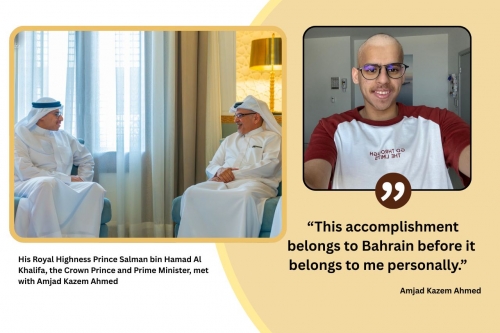
He also received personal support from HRH Prince Salman bin Hamad Al Khalifa, who visited him before treatment and continued to follow up on his condition. After a year, Amjad met him again under improved circumstances. “The last meeting was even better than the first… I visited him when I was in good health,” he said.
Amjad’s journey is not defined by a single medical breakthrough, but by the ongoing process of rebuilding a life once limited by illness. As he continues through this transitional phase, his story reflects resilience, patience, and the quiet determination to move forward step by step.
He also received personal support from HRH Prince Salman bin Hamad Al Khalifa, who visited him before treatment and continued to follow up on his condition. After a year, Amjad met him again under improved circumstances. “The last meeting was even better than the first… I visited him when I was in good health,” he said.
Amjad’s journey is not defined by a single medical breakthrough, but by the ongoing process of rebuilding a life once limited by illness. As he continues through this transitional phase, his story reflects resilience, patience, and the quiet determination to move forward step by step.
Related Posts