

“One million more midwives"
Midwifery - A Strong Pillar of Maternal Care in GCC
TDT | Manama
Email: mail@newsofbahrain.com
Long before a newborn’s first cry echoes through the delivery room, midwives stand beside families through one of life’s most profound and transformative journeys. Across the GCC, their role remains indispensable: helping ensure safer births, healthier mothers, stronger healthcare systems, and fewer unnecessary medical interventions.
This contribution is reflected in the region’s remarkable progress in maternal health, with GCC countries recording some of the world’s lowest maternal mortality rates.
This year’s International Day of the Midwife 2026, themed “One million more midwives, four million lives saved,” places the spotlight not only on increasing the number of midwives but also on transforming the way maternal care is delivered.
In the GCC, this means recognizing midwives as highly skilled professionals who play a pivotal role in supporting women through pregnancy, childbirth, and postnatal care.
Yet challenges remain. To meet the global benchmark of roughly one midwife for every 30 births, the GCC is projected to require an additional 33,450 midwives by 2035, as per UNFPA reports.
At the same time, Caesarean section rates in some countries remain high - ranging between 20 and 33 per cent, well above the WHO’s recommended level of 10 to 15 per cent. This underscores the growing need for stronger midwife-led models of care that encourage safer, more natural births while reducing avoidable interventions.
Yet challenges remain. To meet the global benchmark of roughly one midwife for every 30 births, the GCC is projected to require an additional 33,450 midwives by 2035, as per UNFPA reports.
At the same time, Caesarean section rates in some countries remain high - ranging between 20 and 33 per cent, well above the WHO’s recommended level of 10 to 15 per cent. This underscores the growing need for stronger midwife-led models of care that encourage safer, more natural births while reducing avoidable interventions.
In Bahrain, midwifery is a well-established and regulated profession supported by the Bahrain Nursing & Midwifery Society (BNMS) and leading academic institutions such as the University of Bahrain and RCSI Bahrain.
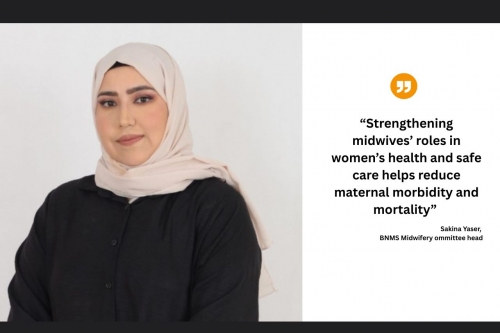
Speaking to TDT, Ms. Sakina Yaser, Board member & Head of the Midwifery Committee, BNMS, & RCSI Alumni said, “Midwives in Bahrain are highly educated, qualified, and well-trained. However, concerns regarding the shortage of midwives have been recognized both locally and internationally by the International Confederation of Midwives, resonating with the ICM theme for 2026 - “one million more midwives.”
The Arab Region Nursing and Midwifery Strategic Framework 2022–2030 emphasizes strengthening midwifery practice, noting its potential to improve 56 health outcomes, including reductions in maternal, neonatal and infant mortality, low birth weight, Caesarean sections, and improved maternal satisfaction.
The Arab Region Nursing and Midwifery Strategic Framework 2022–2030 emphasizes strengthening midwifery practice, noting its potential to improve 56 health outcomes, including reductions in maternal, neonatal and infant mortality, low birth weight, Caesarean sections, and improved maternal satisfaction.
Related Posts