

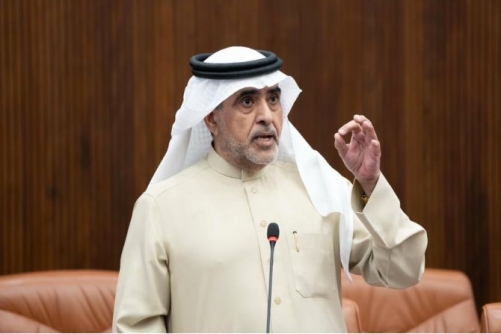
GCC AI Strategy Proposal Heads to Parliament
TDT | Manama
Email: mail@newsofbahrain.com
A proposal calling on the Government to coordinate with Gulf Cooperation Council states on a unified strategy to achieve leadership in artificial intelligence will be debated in Parliament on Tuesday.
Submitted by MPs Khaled Buanaq, Ahmed Al Salloom and Hisham Al Awadhi, the proposal urges a shared Gulf approach that links education with regulation that allows innovation while keeping ethics in view, alongside stronger public-private work and joint planning to share expertise and raise the region’s standing in global technology.
Its sponsors say a single GCC plan would support economic growth through investment in innovation and wider use of artificial intelligence, while helping build specialised local skills. They also argue that structured cooperation would let member states exchange experience in technology and artificial intelligence and improve competitiveness against leading global economies.
In its response, the Ministry of Transportation and Telecommunications said the proposal would add to work on artificial intelligence at both national and regional levels, by keeping focus on shifting challenges and available opportunities. The ministry also pointed to the Arab AI strategy, adopted by Arab ministers of communications and information in Cairo on 23 January 2025, describing it as a ready framework for regional leadership in the field. It said producing a separate GCC strategy could duplicate effort, and instead raised the idea of a specialist working group under the GCC Secretariat-General to review the Arab strategy’s outputs, support its implementation across the Gulf, and examine shared challenges facing member states.
The ministry referred to domestic steps already under way, including plans within the Sixth National Telecommunications Plan to prepare a specialised national AI strategy in coordination with the Telecommunications Regulatory Authority. It also cited the creation of an Innovation and Advanced Technologies Directorate at the Information and eGovernment Authority, tasked with supporting digital development through research, policy work and coordination with academic bodies and major technology firms, as well as helping government entities adopt artificial intelligence to improve service quality.
Several other ministries told the committee the matter does not fall within their direct remit. The Ministry of Health, the Ministry of Justice, Islamic Affairs and Waqf, and the Ministry of Industry and Commerce each said the proposal sits outside their responsibilities. The Ministry of Information Affairs gave the same view, while saying it supports wider national and regional work on modern technology, including artificial intelligence, linked to developing the media sector and strengthening its role in society.
The Ministry of Education welcomed Parliament’s focus on innovation and digital change in schools. It said its strategic map for 2023 to 2026 gives weight to information technology and artificial intelligence as part of work to strengthen digital infrastructure, and that it continues to update curricula and teaching methods in line with developments in artificial intelligence and cybersecurity. The ministry said the general curriculum framework allows these topics to be integrated through regular updates and new courses, including areas such as the digital economy, artificial intelligence, space science and cybersecurity.
The Education Ministry also referred to joint GCC work led by the Secretariat-General, including an AI and Emerging Technologies Working Group made up of member-state representatives. It cited guidance issued at the 45th session of the GCC Supreme Council, held in Kuwait on 1 December 2024, which tasked the Consultative Commission with preparing unified Gulf policies and legislation for the use of artificial intelligence.
The Ministry of Interior, through the Information and eGovernment Authority, recommended a comprehensive unified Gulf strategy, saying it would strengthen cooperation, skills and infrastructure, and support innovation through shared policies and standards. It also referred to a follow-up meeting linked to the sixth gathering of the GCC AI and Emerging Technologies Working Group, held on 24 April 2025, saying Bahrain presented an initiative for a unified GCC AI strategy that was later approved by the GCC Executive Committee for eGovernment meeting in Kuwait. The ministry said Bahrain was tasked with preparing the strategy document and sharing its outputs and recommendations with member states for adoption and for a joint plan to carry it through.
The Nasser Centre for Science and Technology said it was ready to help draft the strategy in line with its aims, describing a unified Gulf approach as a step towards a more joined-up regional system and stronger exchange of knowledge and experience. The centre said the initiative could also support Bahrain’s position as a Gulf hub for artificial intelligence through locally developed solutions, and by drawing on Bahraini university graduates and specialists in the field.
The Legislative and Legal Affairs Committee recommended approval of the proposal, with all members present backing it on public-interest grounds.
Related Posts