

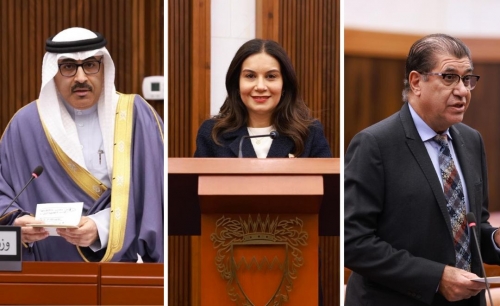
Shura Council Backs New Private Schools Law
TDT | Manama
Email: mail@newsofbahrain.com
Three decades after the last full rewrite of the rules, Shura Council on Sunday agreed, in principle, to a draft law for private educational institutions, with a final vote on the articles put off to a later sitting.
Members debated the Services Committee’s report on the draft law issuing a Private Educational Institutions Law, attached to Decree No. (60) of 2025. Education Minister Dr Mohammed bin Mubarak Juma attended, alongside managers of private schools and kindergartens.
‘The law is about 30 years old, and a lot has changed since then,’ the minister told the chamber. He said the private sector has grown in student numbers, the number of institutions and staffing, while teaching methods, licensing needs and the conditions for setting up schools have shifted. He added that the ministry now covers all education sectors, including early education through nurseries and kindergartens.
Lina Qassim, the committee rapporteur, said the bill aims to regulate private education in line with national education policy, support quality learning, and tighten governance through clearer rules on licensing, management and oversight. She said it also separates private educational institutions from private training institutions, widens the scope of institutions overseen by the Ministry of Education, and strengthens the ministry’s supervisory powers.
Dr Juma said the draft changes the licensing path by introducing an initial approval. The aim is to let an applicant complete procedures with other state bodies before the final licence is issued. ‘Under the current law, you cannot move with other government procedures until you have the final licence from the ministry,’ Dr Juma said. ‘This draft gives an initial approval so the applicant can finish requirements with other bodies and begin operating, which makes it easier for those who want to invest.’
The draft also changes how parents are involved. Private schools would be required to have a Parents’ Council, while early education institutions would be allowed to set up a similar body on an optional basis. It also permits schools to earn extra income by using facilities such as halls, swimming pools and sports grounds for events and rentals, subject to ministry approval.
Financial oversight is also built into the bill. The minister said the ministry would be able to request financial reports and review an institution’s position through specialist departments, to reduce the risk of sudden closures. He said institutions would have to notify the ministry if they are unable to pay the salaries of 5 per cent of their staff.
The committee report also sets out a wider, tiered system of administrative and criminal penalties, replacing what it described as limited measures under the current law. During the debate, First Deputy Chairman of the Shura Council Jamal Fakhro said sanctions and fines would need careful handling, in particular for kindergartens and smaller institutions. He also raised the issue of consultation, saying: ‘The Services Committee sent letters to 14 private educational institutions to take their views on the law, but only one institution responded.’
The minister said most private institutions comply with ministry instructions, but the aim is to raise the performance of low-rated schools through supervisory and remedial plans. He gave a breakdown of violations recorded by the ministry: nine linked to buildings, 15 linked to fees, 118 linked to employment, and eight linked to curricula.
On Bahrainisation, he said the ministry is encouraging private schools to hire Bahrainis, especially in certain specialisms, and is working with the Ministry of Labour and Tamkeen on projects to raise the share of Bahrainis in private schools. He said screening for those entering the sector goes beyond medical tests, through coordination with the Ministries of Interior and Health, with schools providing reports on physical and psychological fitness.
Dr Juma told members public schools still educate most students, with about 157,000 enrolled, compared with 90,000 in private schools, adding that Bahrainis in private schools are fewer than 30,000. He said the draft keeps Arabic, Islamic education and citizenship subjects mandatory for Bahraini students, and that where the draft is silent, the wider education law would apply.
After the debate, the council approved the bill in principle and deferred voting on its articles to a later session.
Related Posts