

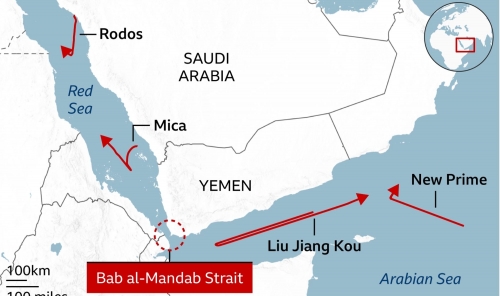
Bab al-Mandeb Strait: another key oil shipping route under threat
Yemen's pro-Iranian Houthi rebels have claimed attacks in the Red Sea on two Saudi oil tankers and say they will blockade the Bab al-Mandeb strait, a crucial passage into the Red Sea, as part of a maritime blockade of Saudi Arabia.
- Gateway to the Red Sea -
Known as the "Gate of Tears" in Arabic, the Bab al-Mandeb strait sits at the southern tip of the Red Sea, connecting it with the Gulf of Aden in the Indian Ocean.
About 100 kilometres (62 miles) long and 30 kilometres (18 miles) wide at its narrowest, it separates Yemen on the Arabian Peninsula from Djibouti and Eritrea on the Horn of Africa.
- Strategic trade route -
With the Red Sea a key link between Europe and Asia, the strait is one of the busiest shipping lanes in the world.
Oil tankers and cargo ships use it to reach the Suez Canal and the Mediterranean, shortening journeys between Asia and Europe and North America by thousands of kilometres.
Around 26,000 ships transited through the Suez Canal in 2023, according to a Suez Canal Authority report -- but this fell to 12,700 by 2025 after Huthi rebels attacked ships in the Red Sea.
- Key oil passage -
Even before the Middle East war, Bab al-Mandeb was a key route for oil shipments, with the US Energy Information Administration (EIA) saying 12 percent of world oil shipments transited the strait in 2023.
Attacks by the Houthis linked to the Gaza war caused shipping to drop dramatically, but Iran's closure of the Strait of Hormuz ramped up its importance once again.
Saudi exports via the Red Sea port of Yanbu approximately tripled to a record high of around four million barrels a day in the spring, according to analysts, before falling back slightly.
That would represent around four percent of pre-war global demand.
John Evans, an analyst at PVM, said exports from Yanbu had now reached 75 percent of Saudi Arabia's peacetime exports.
Andreas Krieg, a security expert at King's College London, said: "A simultaneous crisis at Hormuz and Bab al-Mandeb would produce a much larger shock than either blockade alone".
Much Saudi oil was exported to Asia, he said, meaning that, with Bab al-Mandeb closed, "those vessels would have to sail north through Suez, cross the Mediterranean, pass Gibraltar and travel around Africa before reaching Asia".
Such a journey would take 50 days, said Evans, instead of around 20 on the usual route.
Related Posts