

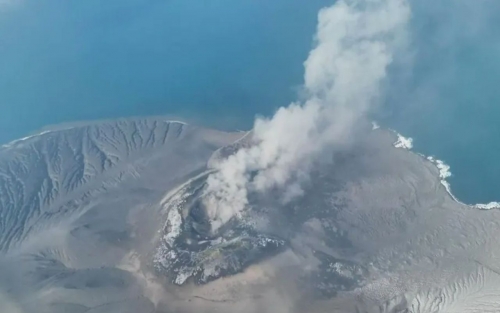
Indonesia’s main airport suspends operations after volcanic eruption
AFP | Jakarta
Email: mail@newsofbahrain.com
About 170,000 passengers were left stranded yesterday as Indonesia shuttered its main international airport and seven others, cancelling hundreds of flights after Mount Anak Krakatoa spewed a plume of volcanic ash and lava from more than 150 kilometres away.
Mount Anak Krakatoa erupted on Saturday, producing a fountain of lava and booming sounds that could be heard up to a few hundred kilometres away, the geology agency said in a statement.
Two new eruptions were recorded on Sunday, the volcanology agency warned.
Ash from the volcano was detected in the airspace surrounding Soekarno-Hatta International Airport, prompting authorities to initially suspend operations from 1:30 am on Sunday (Saturday 1830 GMT) to 5:30 am.
The suspension was extended several times, with the latest extension set to last until midnight, the transportation ministry said in a statement.
Operations have also been suspended at seven other airports, including the Husein Sastranegara airport in Bandung and Radin Inten II airport near Bandar Lampung on Sumatra, the ministry added.
“To date, 1,558 flights have been delayed at the eight affected airports, with 170,000 passengers stranded,” the ministry said.
More than 900 affected flights were to and from the Soekarno-Hatta International Airport, it added.
Several airports in cities including Semarang and Surabaya have been prepared as “alternatives for landing,” Transportation Minister Dudy Purwagandhi said.
Hazard warning
Anak Krakatoa, which means Child of Krakatoa, sits in a strait that separates the islands of Java and Sumatra.
Ships passing through the strait were asked to increase vigilance for possible disruption to navigation safety due to volcanic activities.
Vessels are prohibited from approaching an exclusion zone of three kilometres radius from the volcano, local port authorities said in a statement.
The volcano has been sporadically active since it emerged from the sea at the beginning of last century in the caldera that formed after the 1883 eruption of Mount Krakatoa.
That disaster was one of the deadliest and most destructive in history with an estimated 35,000 people killed.
A 2018 tsunami triggered by a collapse of parts of Anak Krakatoa killed 429 people and left thousands displaced.
Indonesia, a Southeast Asian archipelago nation, sits on the Pacific Ring of Fire, where the meeting of continental plates causes high volcanic and seismic activity.
Related Posts