

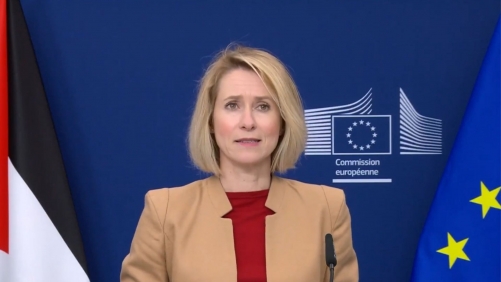
Kaja Kallas Urges Urgent Action as Middle East Faces “Risk and Opportunity”
European Union foreign policy chief Kaja Kallas has reaffirmed that the two-state solution remains the most viable path to lasting peace in the Middle East, as regional tensions continue to pose both risks and opportunities for diplomacy.
Speaking in Brussels during high-level meetings, Kallas highlighted the fragile nature of current ceasefires involving Iran and Lebanon, warning that these temporary pauses in conflict present only a narrow window for de-escalation. She stressed that without meaningful diplomatic progress, the region could quickly slide back into instability and war.
Kallas also drew attention to growing concerns over security in the Strait of Hormuz, where uncertainty over maritime access and potential “pay-for-passage” schemes could set a dangerous precedent for global trade routes. She emphasized that such developments could have far-reaching consequences beyond the region, impacting international shipping and economic stability.
Amid the focus on broader geopolitical tensions, Kallas underlined that the European Union remains firmly committed to supporting the Palestinian people. She described Europe as the largest donor and strongest backer of Palestinian institutions, including governance, policing, and border management. According to her, continued support for Gaza and the West Bank remains a central priority in ongoing discussions.
Reiterating the importance of a political solution, Kallas stated that progress toward a two-state framework has been limited despite years of conflict. She called on Israel to halt settlement expansion, address settler-related violence, and release withheld tax revenues owed to Palestinians. At the same time, she urged the Palestinian Authority to implement necessary reforms, while noting that Hamas’s refusal to disarm remains a significant obstacle to peace.
The discussions also focused on governance in Gaza, with emphasis on coordination between the Palestinian Authority and administrative bodies to ensure effective leadership and avoid fragmentation. International cooperation, she said, is crucial to stabilizing the region and preventing further escalation.
Looking ahead, Kallas highlighted the immense challenge of rebuilding Gaza. A recent assessment conducted in collaboration with the World Bank and the United Nations estimates that reconstruction efforts could cost at least $71 billion. She stressed that coordinated global support will be essential to meet humanitarian needs and lay the foundation for long-term recovery.
Concluding her remarks, Kallas emphasized that the Middle East stands at a critical crossroads. While the current moment offers a chance to advance peace, she warned that failure to act decisively could reverse fragile gains and deepen regional instability.
Related Posts