

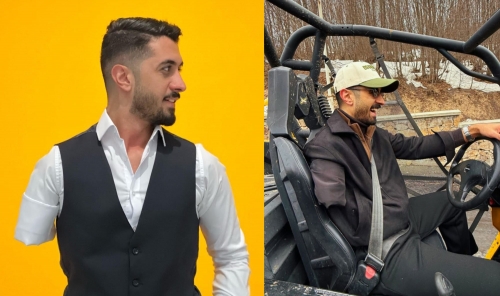
'One Hand Is Enough': Bahrain Man Turns Tragedy Into Inspiration
Fourteen years after a friend's reckless driving cost him his right hand, Saif Laila recently sat behind the wheel again for a drift session, this time in a controlled, safe setting. He is quick to say it was not about closure. "I made peace with what happened to me a long time ago," he told The Daily Tribune in an exclusive interview. "I just wanted to try the experience and share it with people, and of course connect it to what happened to me."
He was 14 at the time of the accident. He is 28 now, and there is no gap in his memory of it, no blackout that softened the moment. "I didn't receive the news, I lived through the whole experience," he said. "There was no loss of consciousness. I woke up and saw the amputation. It happened in that moment."
Two things carried him through what followed, he said: his faith and the people closest to him. "The belief that this was destiny from God, was the biggest factor," he said, "along with the role played by my family and the environment around me." Even so, adjusting took time. Coming to terms with it psychologically took about a year to 18 months, he said, while relearning the practical skills of daily life took three to four years, spread across the years he spent finishing school and then starting university.
Writing was the first real difficulty. He had always written with his right hand and had to learn to do it with his left instead. But the harder challenge, he said, came after he left hospital, in the way people looked at him. "With God's grace I overcame it," he said, "and what used to be a painful look became one I use in a positive way, trying to send a good message to people who see me on the street."
That shift changed how he saw his own story. He began to notice that people who felt hopeless because of their own circumstances responded differently when they saw what had happened to him. "They were affected positively," he said. "They saw that there is hope in life."
He said the misconception he encounters most often, particularly among the families and friends of amputees, is the assumption that losing a limb means losing the ability to cope. Changing that idea is behind his motto, "One hand is enough." "It's about being capable as a person, whatever your circumstances, whatever you've lost in life," he said. "With whatever abilities and resources you have today, you are enough to develop and reach whatever dream you want to reach one day, God willing." The phrase grew out of conversations with strangers who stopped him in the street, assuming at first that his life must be limited, then realising otherwise once they had spoken to him. Since he cannot speak to everyone who sees him, sometimes hundreds of people in a day, he decided a written message could do that work instead.
Asked what he considers his biggest personal achievement, he pointed first to his own state of mind, the confidence that he can meet any challenge, and the fact that something painful became something that helps other people. Close behind, he said, is being able to support other amputees and their families. He recalled a former teacher, who had helped him through his own recovery at school, calling years later to ask him to help a relative who had also lost a limb. "It was an unusual feeling," he said, "the moment I arrived and saw the effect on that person and their family."
Asked what message he would give the world, Laila said: "You are capable today of changing the way you think, and of seeing that you have far greater capacity than what others may have convinced you of, or made you feel you don't deserve what you're hoping for. That is their opinion. But your will and your ability, given to you by God, are far greater than the opinions of the people around you."
Related Posts